✨ New Arrivals Just Dropped!Explore
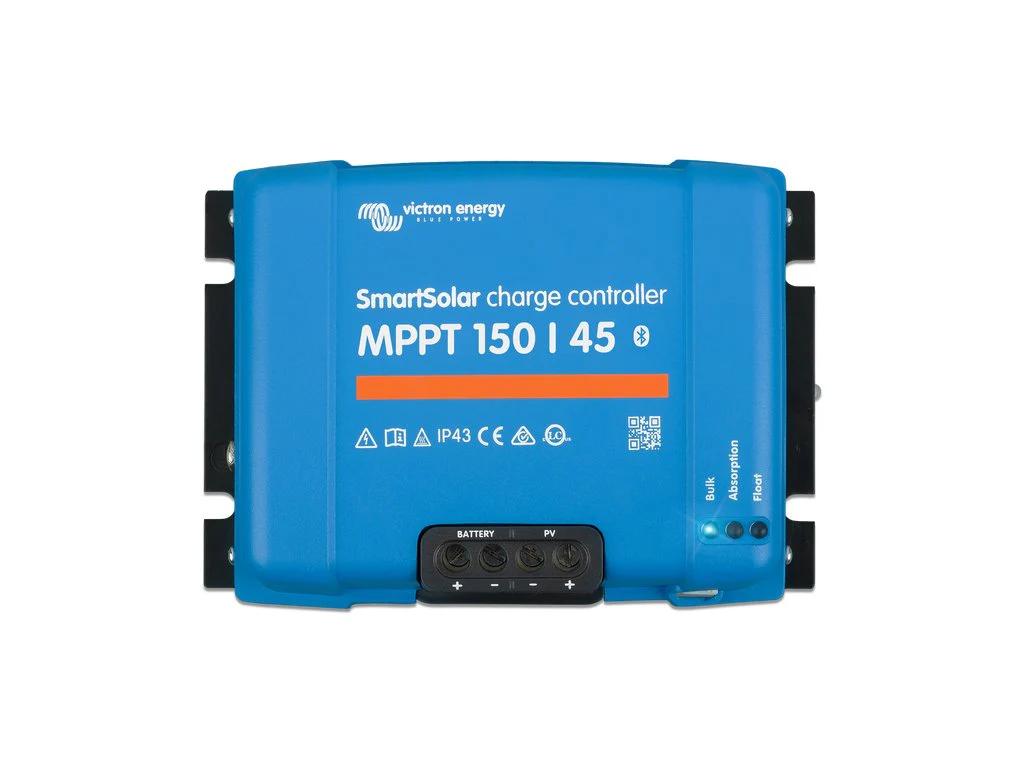
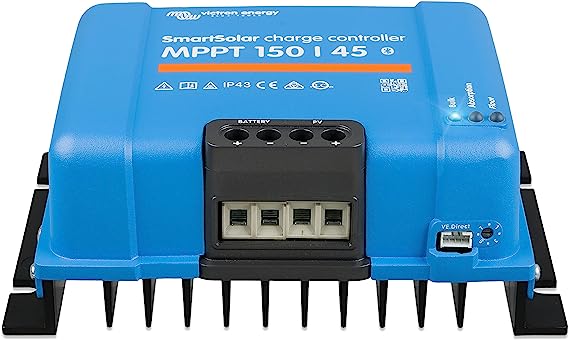
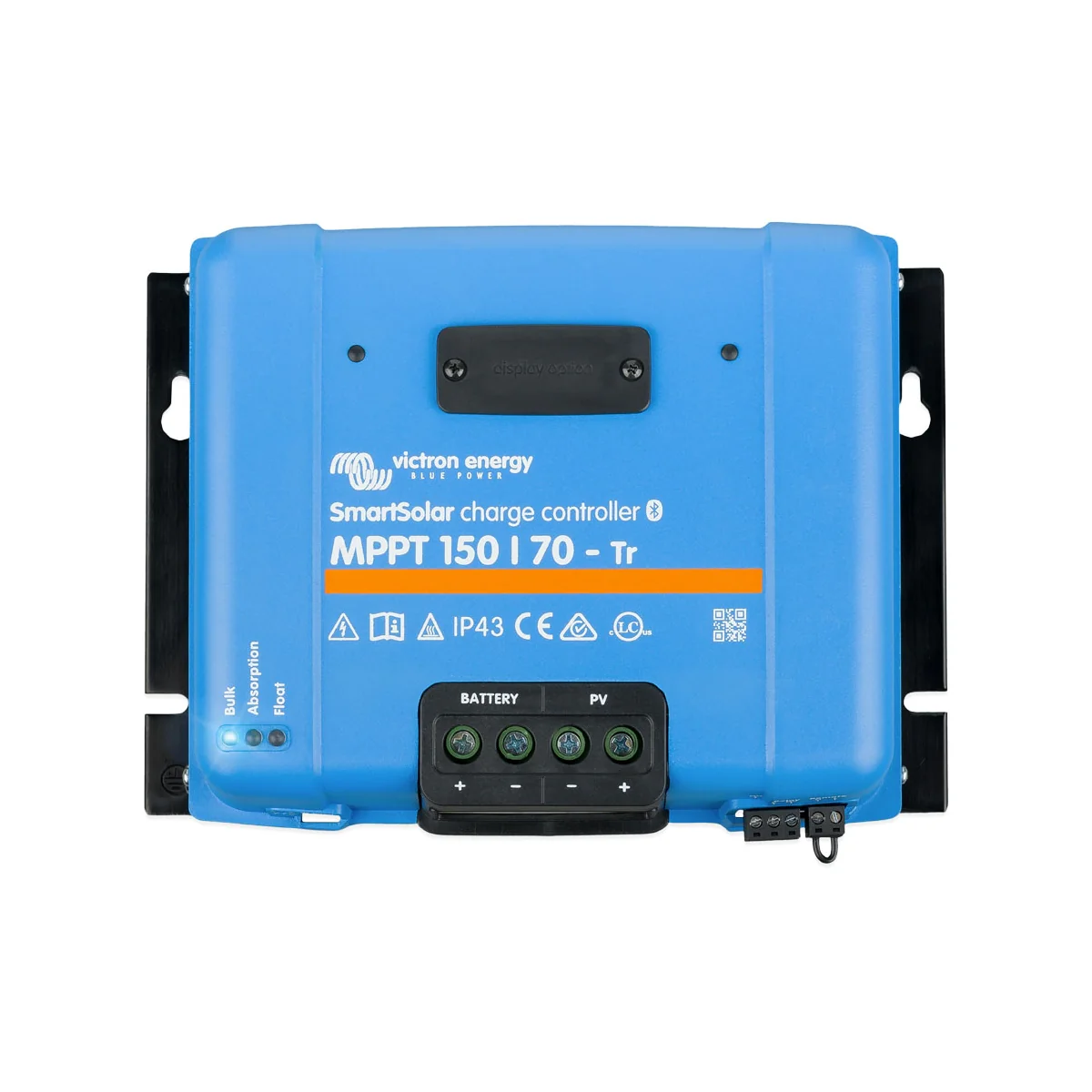
Victron SmartSolar MPPT 250/100-Tr VE.Can Solar Charge Controller 100A 250V — Bluetooth GX VRM Off-Grid Large System
HomeStore

Victron SmartSolar MPPT 250/100-Tr VE.Can Solar Charge Controller 100A 250V — Bluetooth GX VRM Off-Grid Large System

Victron SmartSolar MPPT 250/100-Tr VE.Can Solar Charge Controller 100A 250V — Bluetooth GX VRM Off-Grid Large System

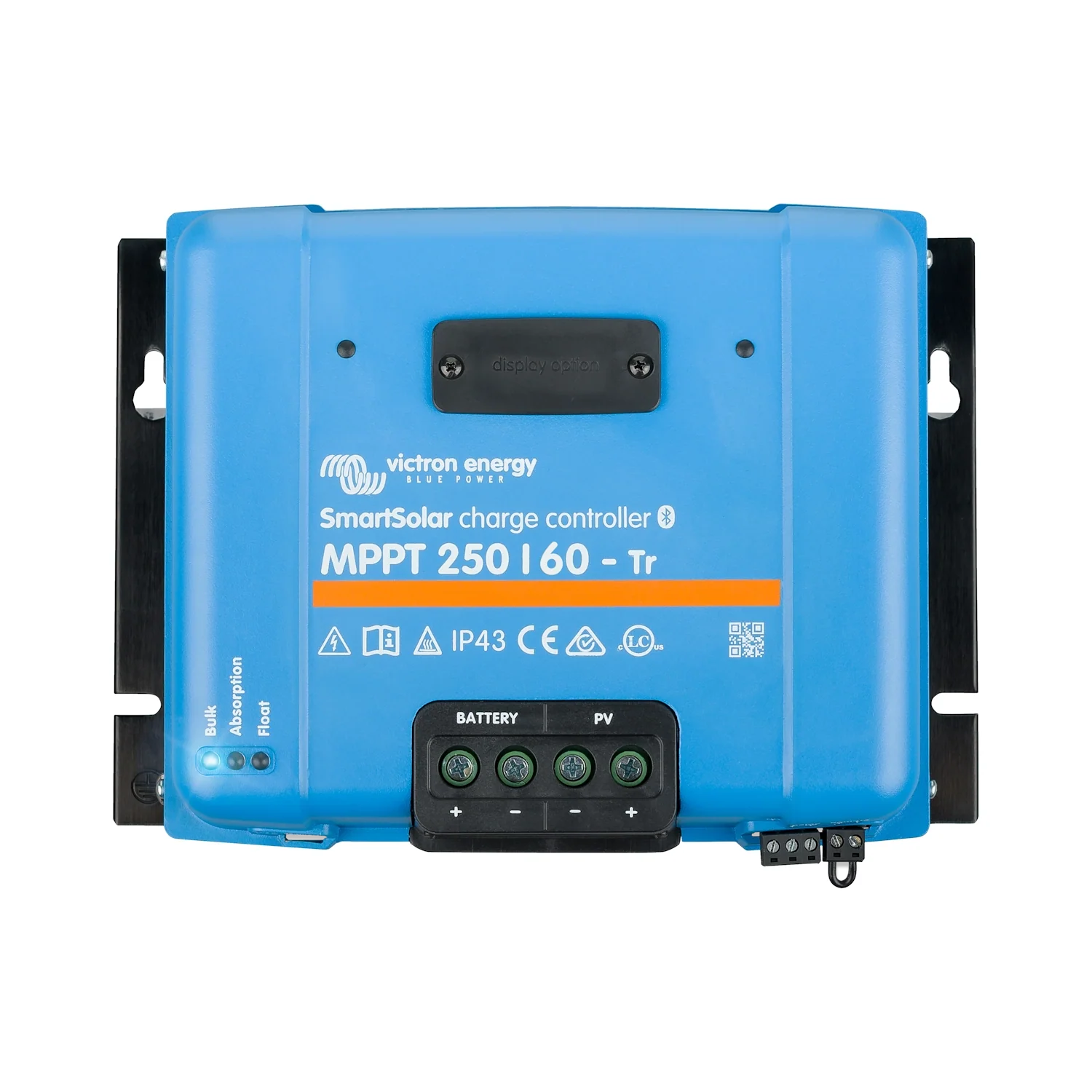
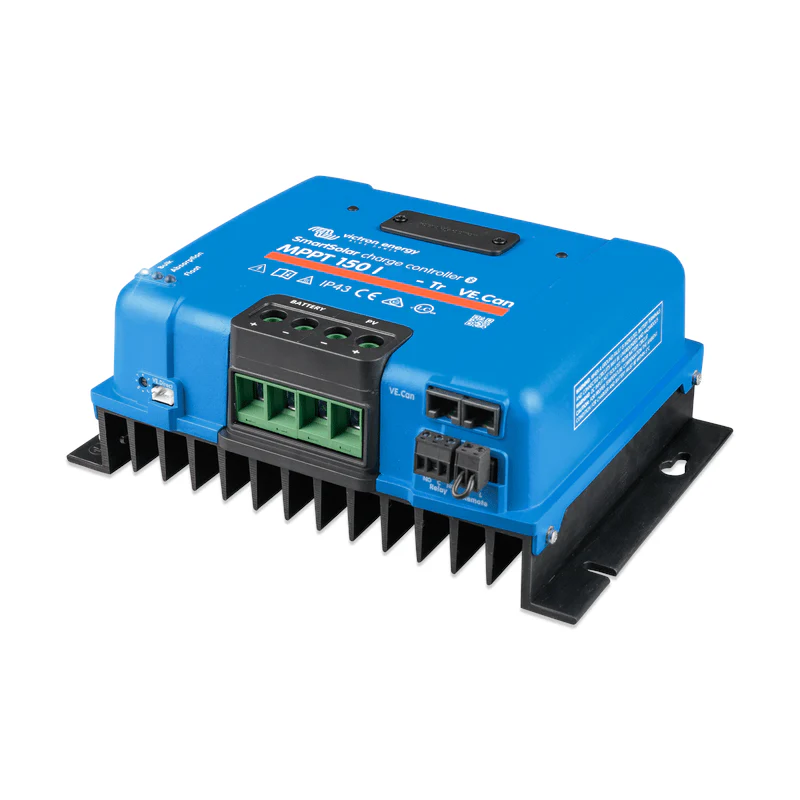
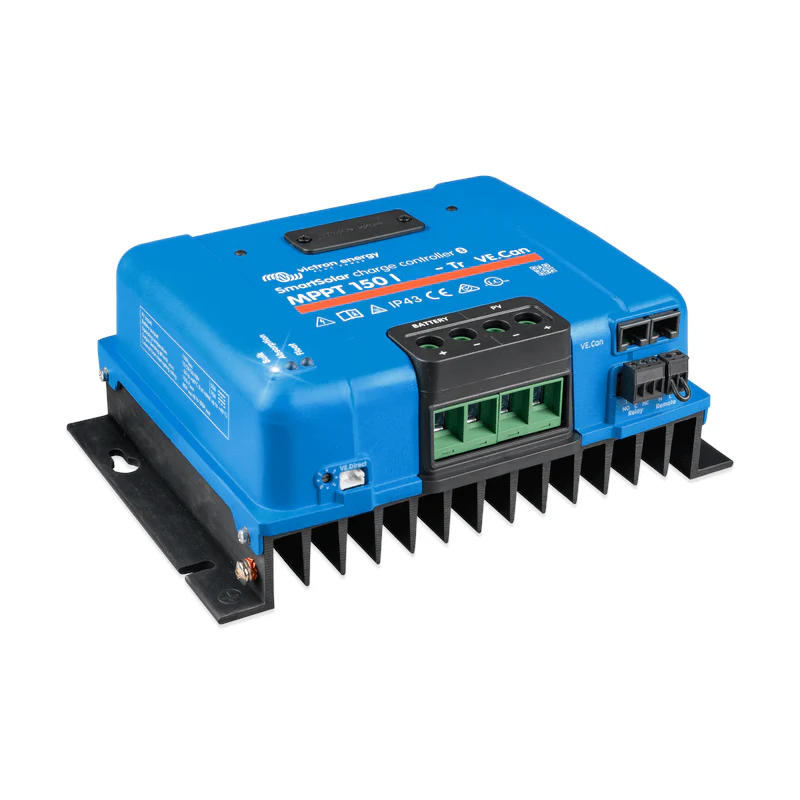
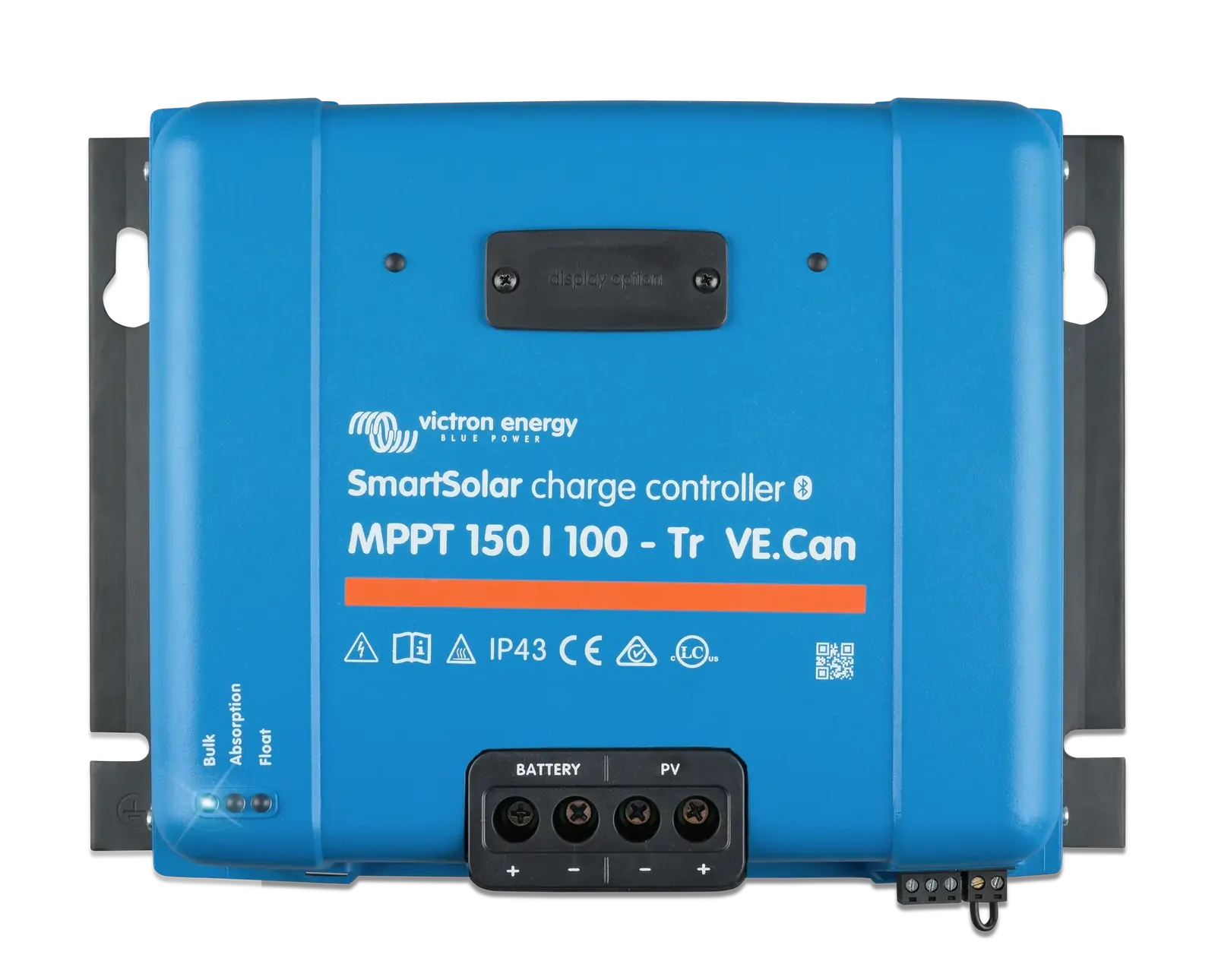
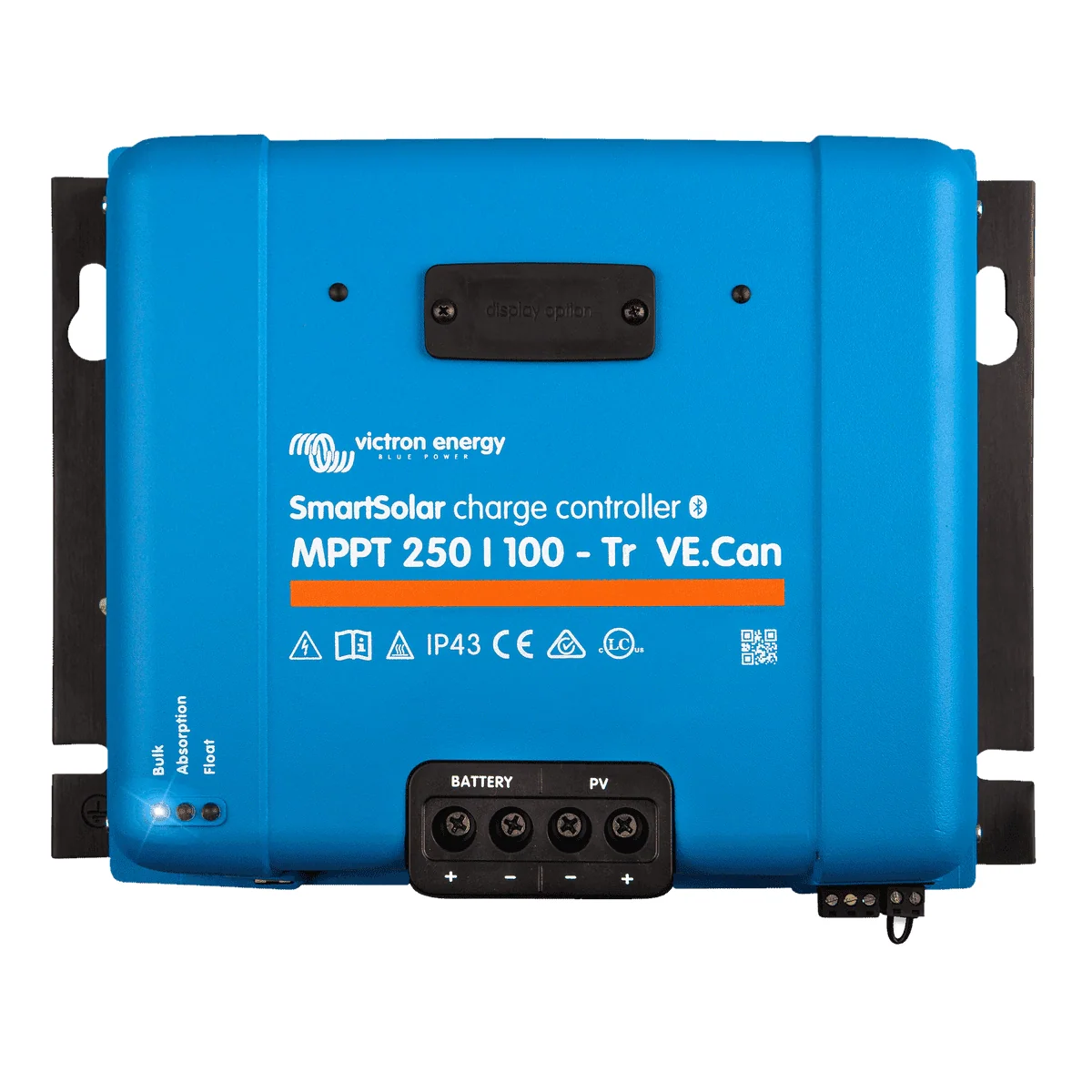
The Victron SmartSolar MPPT 250/100-Tr VE.Can is Victron Energy's flagship large-system solar charge controller — a 100A, 250V MPPT controller for 12V, 24V, 36V, and 48V battery banks, with built-in Bluetooth, VE.Can CAN bus networking, and VE.Direct. The Tr (screw terminal) variant accepts up to 35mm² cable on both PV and battery connections, making it the natural choice for commercial-scale and large residential off-grid and hybrid solar installations. Maximum efficiency exceeds 99% with no cooling fan. Supports up to 5,800W of PV on a 48V bank. The VE.Can port allows up to 25 units to be daisy-chained with synchronised charge stages and single-cable reporting to a GX device and the Victron Remote Management (VRM) portal. Advanced partial-shade MPPT algorithm, BatteryLife adaptive charging, fully discharged battery recovery (including Li-ion with integrated BMS disconnect), and an 8-programme + fully customisable charge algorithm. Programmable DPST relay, remote on/off, and an optional plug-in LCD display. Certified to EN/IEC 62109-1, UL 1741, and CSA C22.2. 5-year Victron warranty.

ℹ Tr vs MC4 — Which Variant Do You Need?
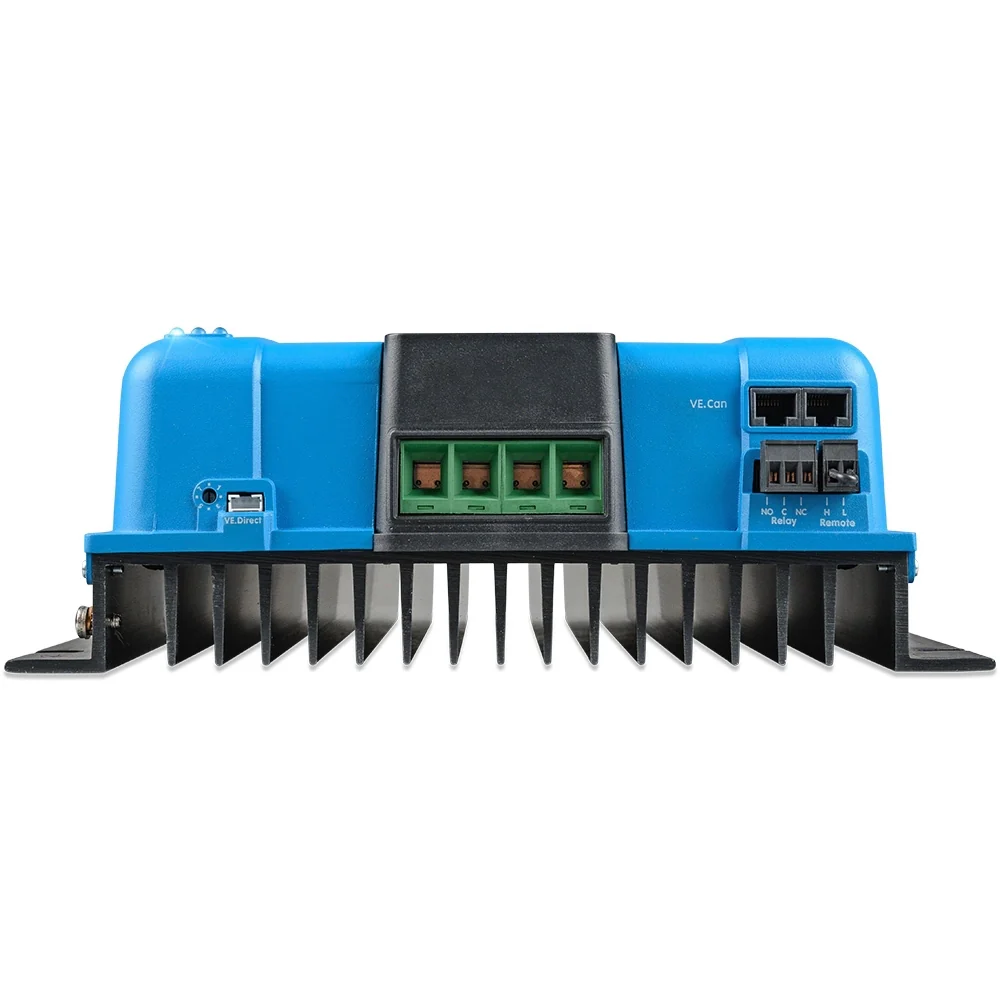
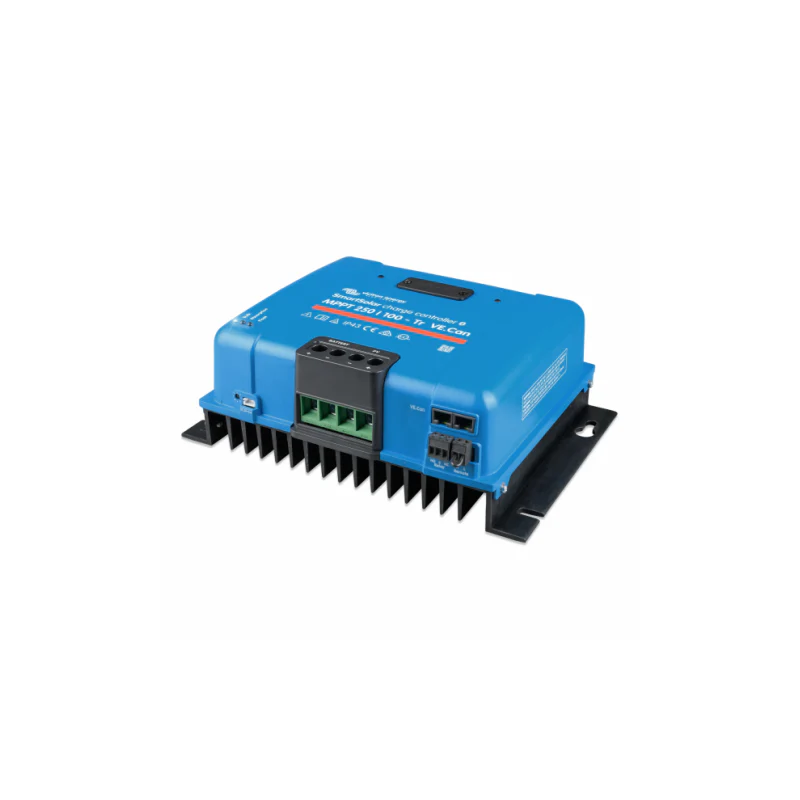
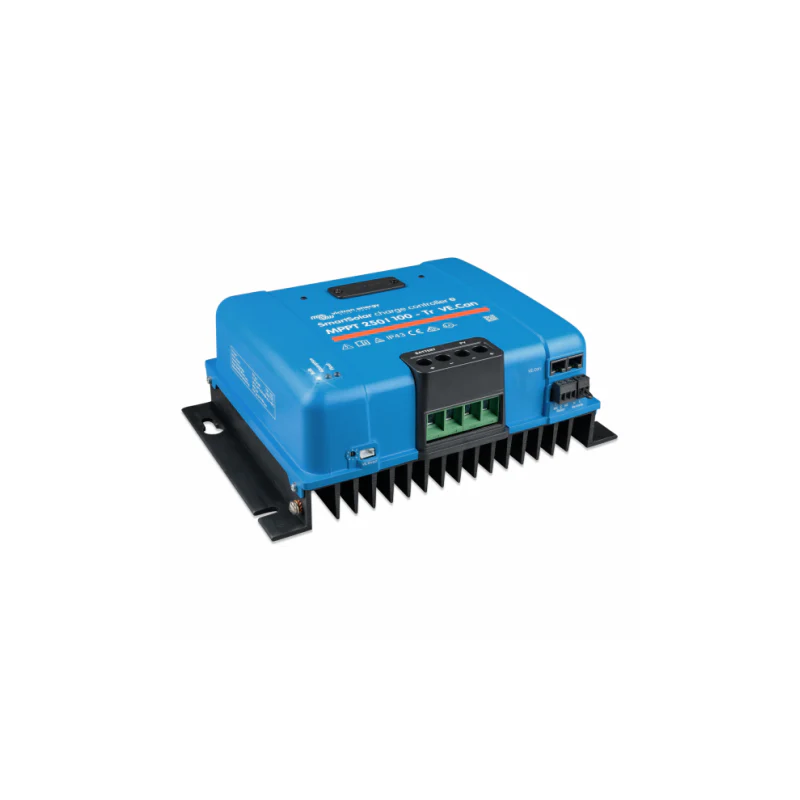
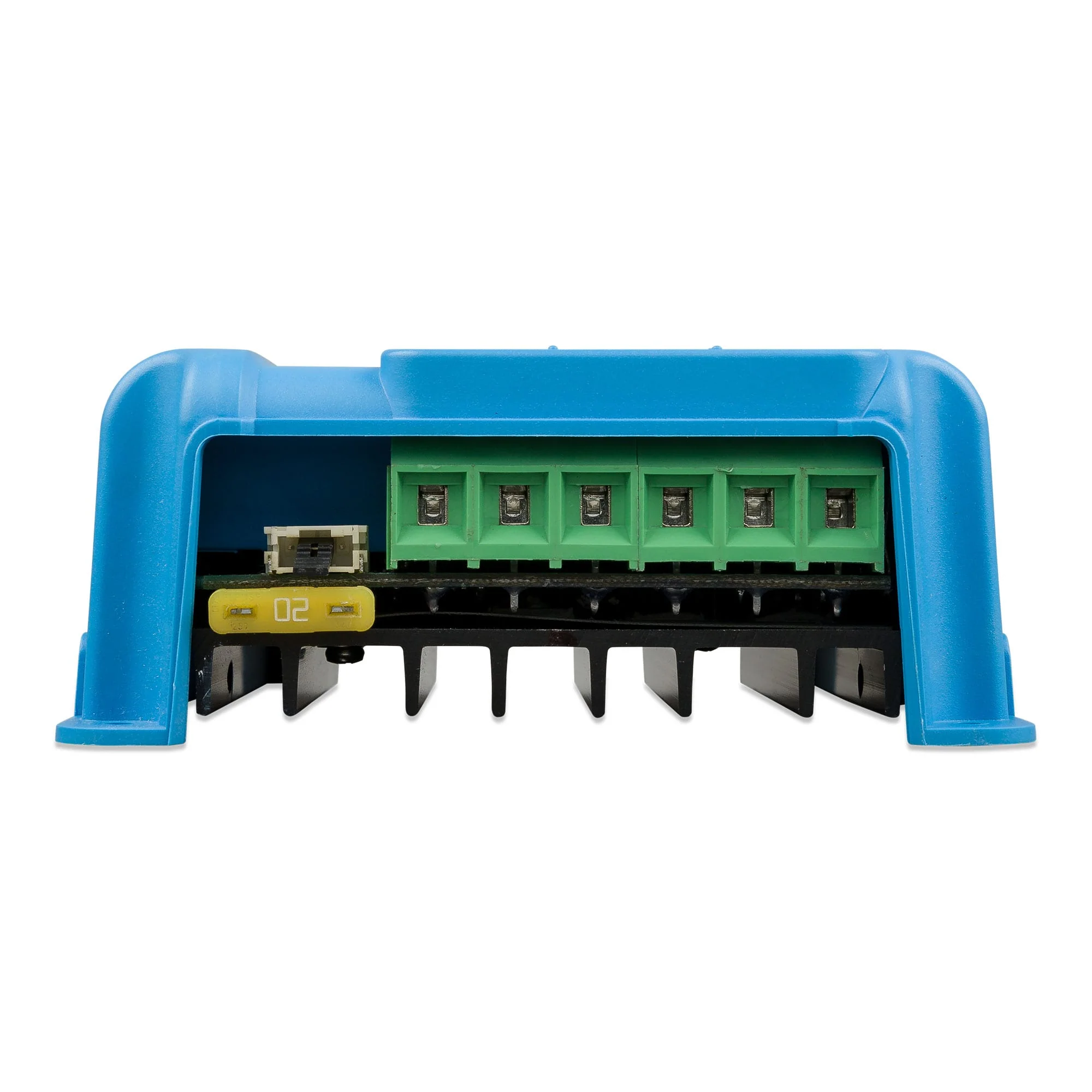
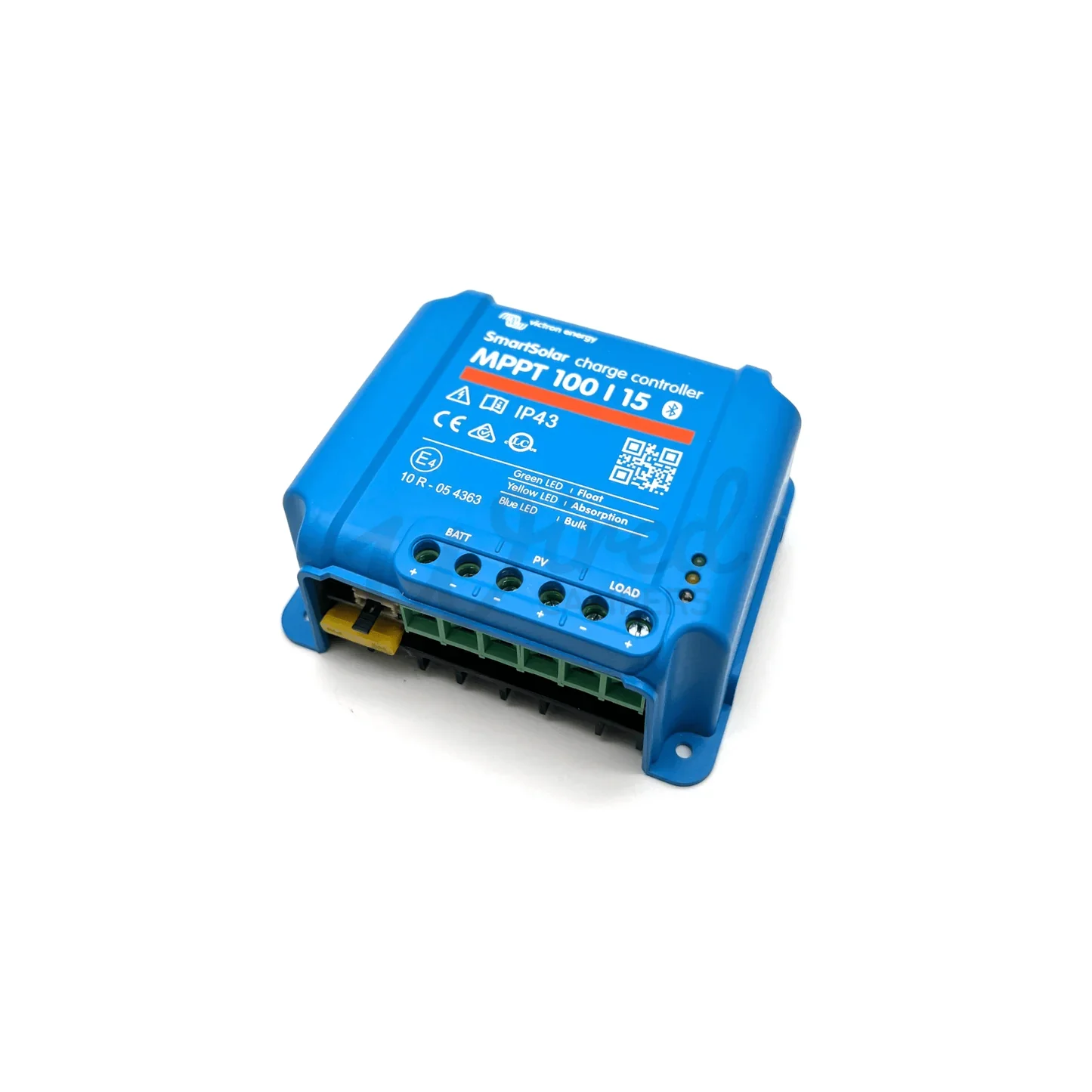
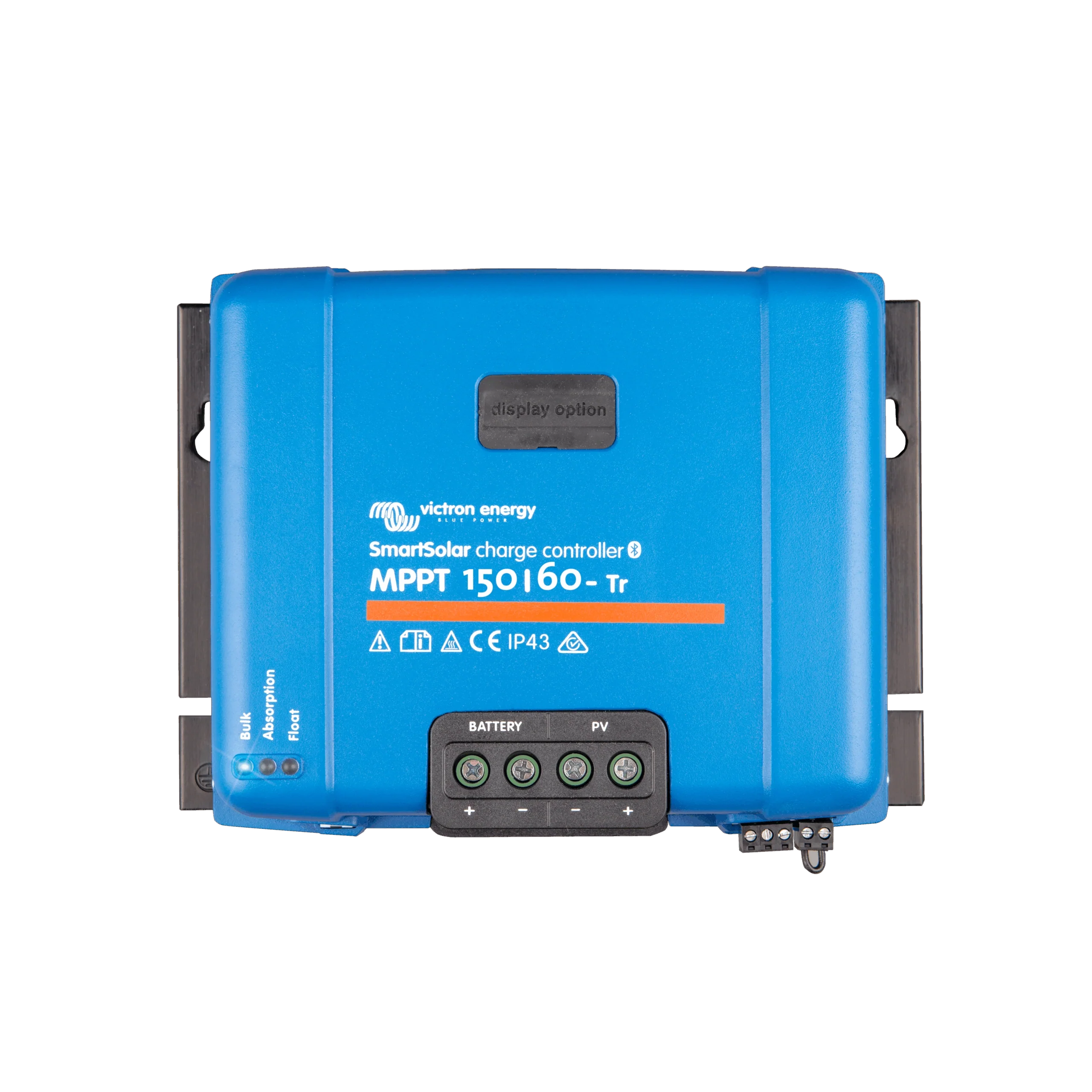
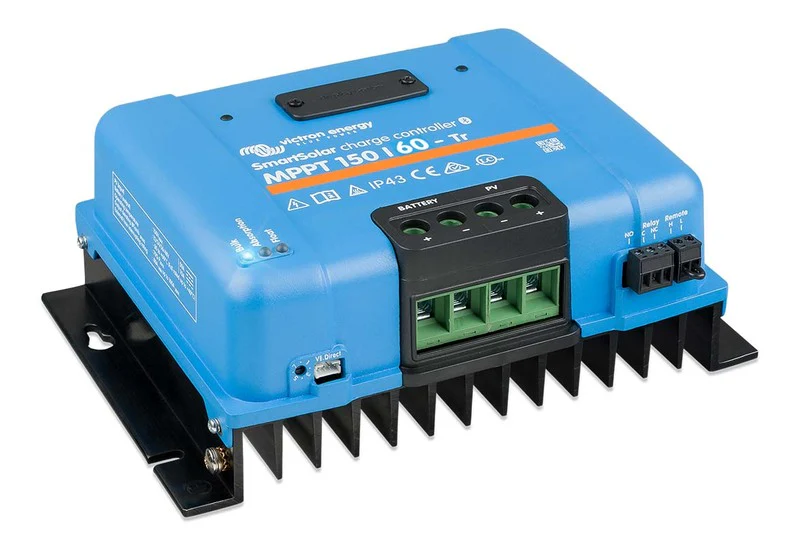
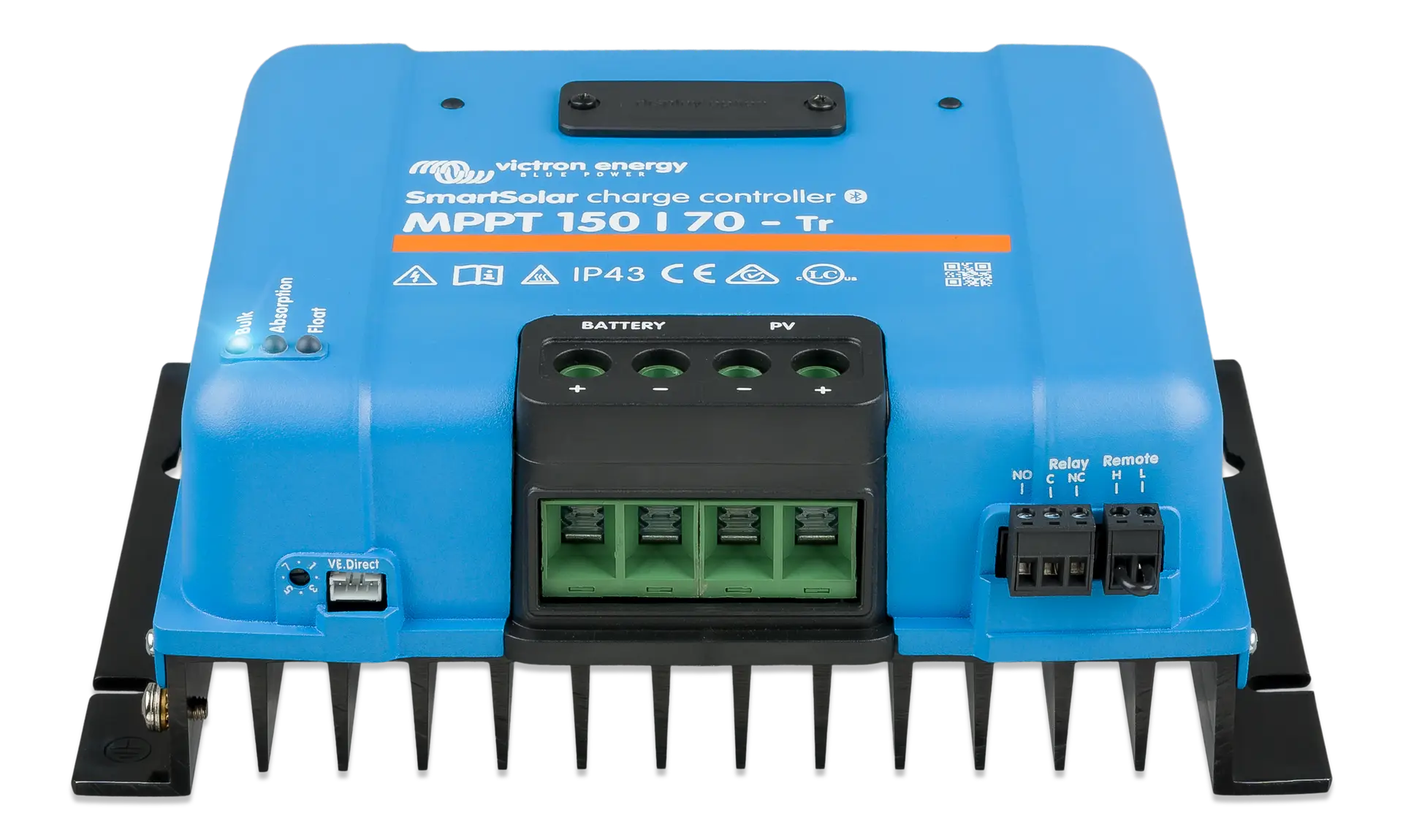
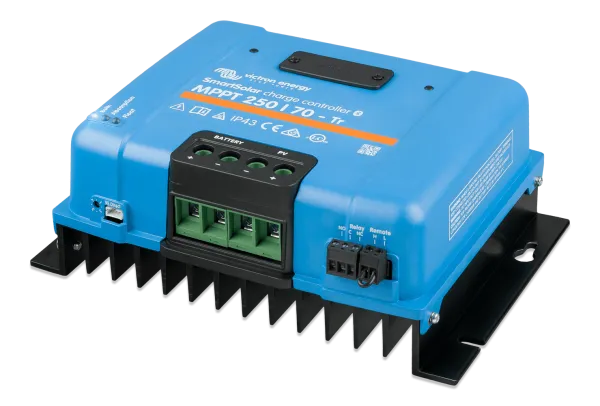
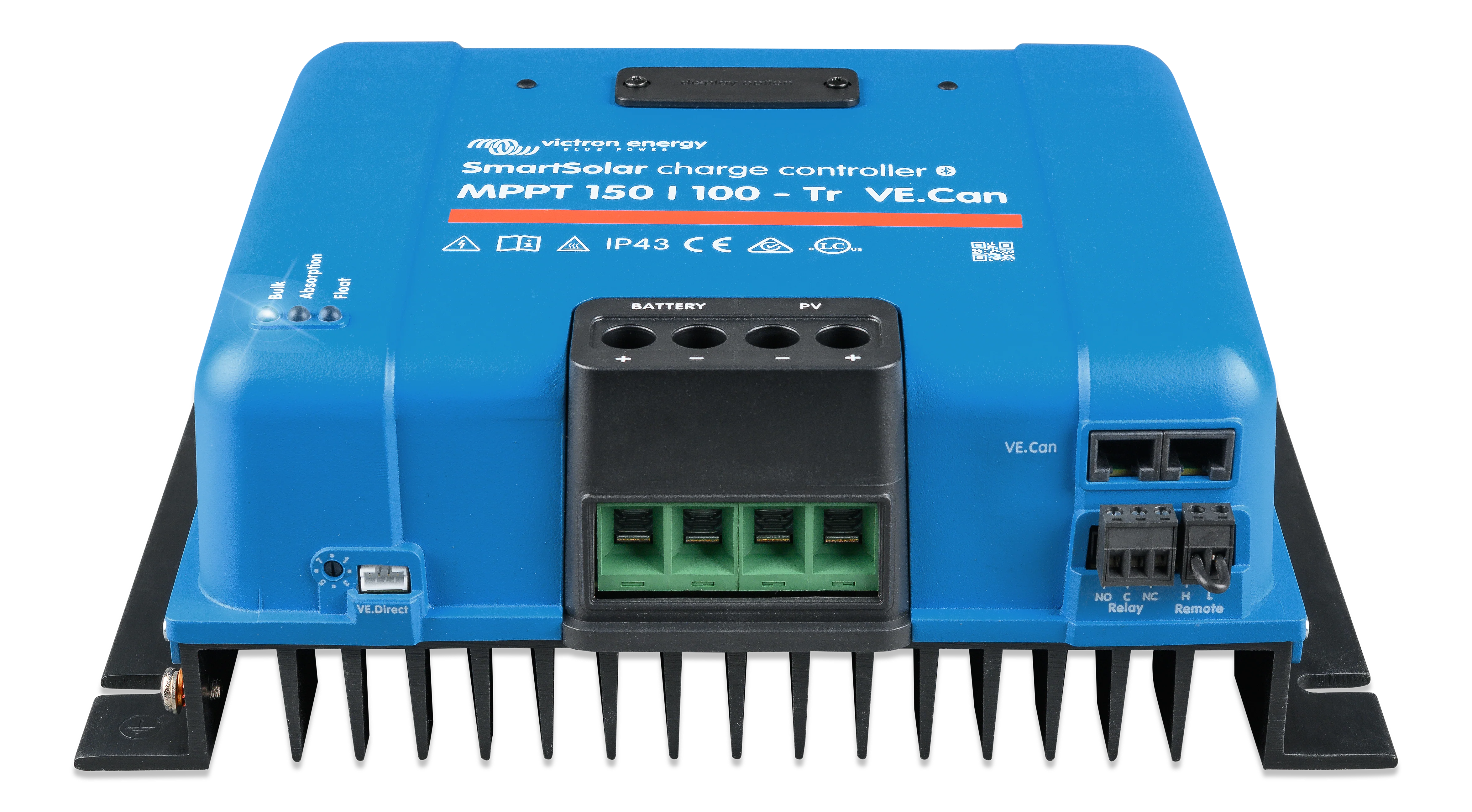
This is the Tr (screw terminal) version: PV and battery connections use 35mm² screw terminals — the correct choice for fixed installations where cable is terminated at the controller, such as building-mounted solar arrays, off-grid cabins, and commercial installations where MC4 connectors on the array side are already in place and the DC cable run terminates at the charge controller with lugs or ferrules.

The MC4 variant adds MC4 connector pairs directly on the controller body — more convenient when the array cables run directly to the charge controller without an intermediate DC combiner, typically in smaller or van/boat installations. For large arrays with multiple string combiner boxes, the Tr terminal is the more practical choice.
100A
Charge current
250V
Max PV Voc
5,800W
PV @ 48V
>99%
Max efficiency
×25
VE.Can daisy-chain
Features & Benefits
✔ Ultra-Fast MPPT with Partial Shade Algorithm
Victron's ultra-fast Maximum Power Point Tracking continuously sweeps the PV I-V curve to find and lock on to the true maximum power point — delivering up to 30% more energy than PWM controllers and up to 10% more than slower MPPT controllers in variable-light conditions. Critically, the SmartSolar algorithm addresses partial shading: when shade creates multiple local power peaks on the I-V curve, conventional MPPTs lock to the nearest local peak. Victron's algorithm evaluates the full curve and locks to the global optimum — extracting more power from partially shaded arrays that would otherwise underperform significantly.
✔ VE.Can — 25-Unit Daisy Chain
The VE.Can CAN bus port (two RJ45 connectors) allows up to 25 SmartSolar VE.Can units to be networked together with a single RJ45 patch cable between each unit. When networked: all units synchronise charge stages simultaneously (all switch from bulk to absorption at the same point rather than independently), they share data to a single GX device via one cable, and each controller can be monitored individually on a Cerbo GX, Color Control GX, or the VRM portal. This makes the 250/100 VE.Can the building block of very large off-grid systems — up to 2,500A of coordinated charging from 25 units on a single GX-managed bus.
✔ Bluetooth + VRM Remote Monitoring — Free
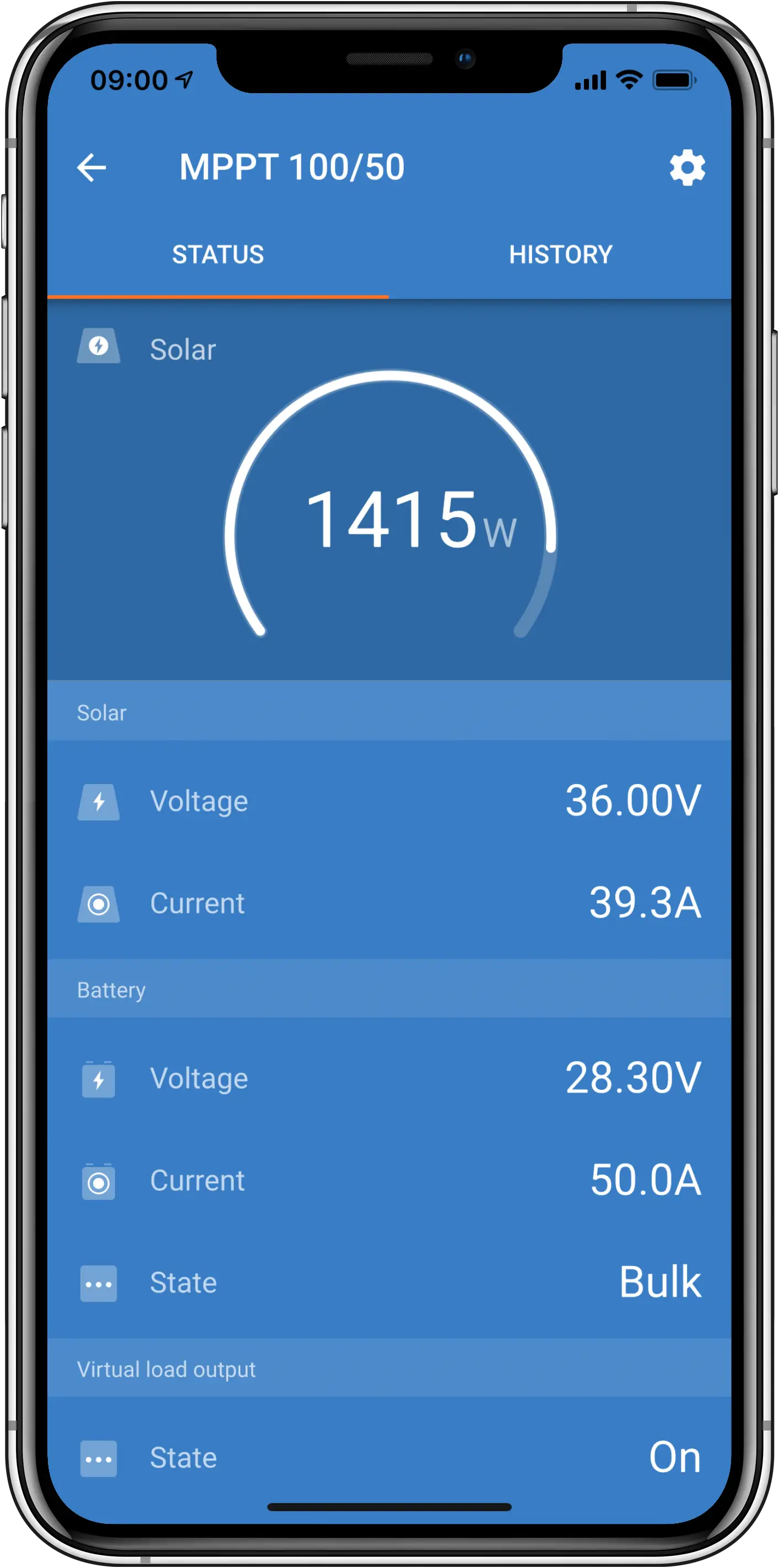
Built-in Bluetooth Smart enables direct connection to the VictronConnect app (iOS and Android, free) for setup, monitoring, and firmware updates without additional hardware. In connected installations, a GX device (Cerbo GX, Venus GX) relays data to the Victron Remote Management (VRM) portal — providing a full web dashboard with 46 days of stored trend data (battery voltage, current, temperature, PV voltage, PV current, load output) and cloud-based alarm notifications. VRM is free for all Victron users with no subscription. Up to 10 units can also be synchronised via Bluetooth without VE.Can if a simpler network is preferred.
✔ BatteryLife — Adaptive Discharge Protection
BatteryLife is Victron's intelligent battery protection algorithm for systems where the solar array cannot guarantee a daily 100% recharge — typical in winter or extended overcast periods. BatteryLife monitors whether the previous day achieved a full charge cycle. If it did not, it incrementally raises the load disconnect threshold, reducing the depth of discharge over successive days, until a full recharge is achieved. This prevents the progressive deep discharge that kills lead-acid batteries when used in under-solar-powered systems. BatteryLife is active by default for lead-acid and compatible battery types; for lithium batteries with their own BMS, load control is handled differently.
✔ Fully Programmable Charge Algorithm — 8 Presets
Eight pre-programmed charge algorithms are selectable via a rotary switch on the controller body, covering sealed lead-acid, flooded, gel, AGM, lithium iron phosphate, and other chemistries — no app or laptop required for standard battery types. For specialist batteries or custom requirements, every charge parameter is fully programmable via VictronConnect, VE.Direct USB cable, or the optional LCD display: absorption voltage, float voltage, equalisation voltage, temperature compensation coefficient (−16/−32/−64 mV/°C), absorption time, and more. A built-in internal temperature sensor provides compensation automatically; an external sensor (Smart Battery Sense, BMV-712, or SmartShunt) connected via Bluetooth gives even more accurate compensation at the battery terminals.
✔ 99%+ Efficiency — No Fan — IP43 / IP22
Maximum conversion efficiency exceeds 99% through natural convection cooling alone — no cooling fan means no moving parts, silent operation, no fan failure risk, and no need to keep fan intake vents clear of dust in dirty environments. Full rated 100A output is available from −30°C to +40°C, with power derating above 40°C and up to the maximum operating temperature of +60°C. Rated to 5,000m altitude (full output to 2,000m). IP43 electronics / IP22 connection area — suitable for indoor and protected enclosure mounting. Dimensions 216 × 295 × 103mm (Tr); weight 4.5kg.
✔ Programmable DPST Relay + Remote On/Off
The built-in programmable DPST relay can be configured to trigger on a wide range of conditions: alarm states, SOC thresholds, battery voltage levels, PV power thresholds, timer events, or temperature limits — making it useful for controlling generator start signals, alarm sounders, contactors, or other automation outputs. Rated 240VAC / 4A and 4A up to 35VDC (1A to 60VDC). The remote on/off connector allows external control of the charge controller — used, for example, by a VE.BUS BMS to cut charge input to a lithium battery when it is full or at temperature limits, without requiring a separate contactor in the DC circuit.
✔ Dead Battery Recovery — Zero Volt Start
The SmartSolar 250/100 will initiate charging from a fully discharged battery at 0V — a critical feature for off-grid systems where a battery may have been inadvertently run to zero during an extended no-sun period. For lithium batteries with an integrated BMS disconnect (which opens the battery relay when the pack is fully depleted), the SmartSolar will detect and attempt reconnection to the battery, re-enabling charging once the BMS reconnects. This prevents the "locked out" scenario where a flat lithium pack cannot be recharged by a controller that requires a minimum battery voltage to start.
Technical Specifications — SmartSolar MPPT 250/100-Tr VE.Can
Manufacturer / Model Victron Energy — SmartSolar MPPT 250/100-Tr VE.Can
Battery Voltage 12 / 24 / 48V (auto-detect) · 36V (manual set)
Rated Charge Current 100A
Max. PV Open Circuit Voltage 250V absolute max (coldest conditions) · 245V operating max
Max. PV Short Circuit Current 70A
Nominal PV Power — 12V 1,450W
Nominal PV Power — 24V 2,900W
Nominal PV Power — 36V 4,350W
Nominal PV Power — 48V 5,800W
Maximum Efficiency >99% — fanless natural convection
Self Consumption <35mA @ 12V · <20mA @ 48V
Default Absorption Voltage 14.4 / 28.8 / 43.2 / 57.6V (fully adjustable)
Default Float Voltage 13.8 / 27.6 / 41.4 / 55.2V (fully adjustable)
Charge Algorithm Multi-stage adaptive — 8 pre-programmed or fully custom
Temperature Compensation −16 / −32 / −64 mV/°C (internal sensor; external via Bluetooth)
Data Communication VE.Can · VE.Direct · Bluetooth Smart
Parallel Operation Up to 25 units via VE.Can · up to 10 units via Bluetooth
Remote On/Off Yes — 2-pole connector
Programmable Relay DPST · 240VAC/4A · 4A to 35VDC · 1A to 60VDC
PV Terminals (Tr) Screw — 35mm² / AWG2
Battery Terminals Screw — 35mm² / AWG2
Protection PV reverse polarity · Output short circuit · Over-temperature
IP Rating IP43 (electronics) · IP22 (connection area)
Operating Temperature −30°C to +60°C (full output to +40°C)
Altitude 5,000m max (full output to 2,000m)
Humidity 95% non-condensing
Dimensions (H × W × D) 216 × 295 × 103 mm
Weight 4.5 kg
Colour Blue (RAL 5012)
Stored Trend Days 46 days (battery V/I/T, PV V/I, load output)
Certifications EN/IEC 62109-1 · UL 1741 · CSA C22.2
Warranty 5 years (Victron Energy)
Frequently Asked Questions
How much PV array can I connect, and how do I size it correctly?
The 250/100-Tr VE.Can accepts a maximum PV open-circuit voltage (Voc) of 250V — this is the hard limit and must not be exceeded under any conditions, including coldest ambient temperatures (when Voc is at its highest). The maximum PV short-circuit current (Isc) is 70A. Nominal array size depends on battery voltage: 12V bank → 1,450W; 24V → 2,900W; 48V → 5,800W. You can connect a larger array than these figures — the controller will simply clamp its input power — but the Voc and Isc limits remain absolute hard limits that must never be exceeded. For array sizing, calculate the maximum cold-weather Voc of all series panels (Voc at −10°C if your location reaches that), and ensure it stays below 245V operating maximum. A PV design tool or Victron's online MPPT calculator will confirm compliance.
What GX device do I need for VRM monitoring and VE.Can networking?
Any Victron GX device with a VE.Can port will work: the Cerbo GX (most popular for new installations, includes Touch 50 display option), the Venus GX, or the Color Control GX. The GX device connects to one unit in the daisy-chain via a single RJ45 cable — all 25 linked units report through this single connection. The GX device requires an internet connection (Ethernet or LTE with a GX LTE modem) to push data to the Victron VRM portal (free, no subscription). Without internet, the GX device still provides local monitoring via its display or the local VRM network interface. Bluetooth-only setups (no GX device) support up to 10 synchronised units and local monitoring via VictronConnect only — no cloud access.
Is this compatible with lithium (LiFePO₄) batteries?
Yes — the SmartSolar 250/100 fully supports lithium iron phosphate (LiFePO₄) and other lithium chemistries. The charge voltages are fully programmable to match the lithium battery manufacturer's specifications (typically 14.2V absorption / 13.5V float on 12V LiFePO₄). The remote on/off connector integrates with lithium BMS units — the BMS can cut the charge input signal when the pack is full or at temperature limits without requiring an external charge relay. The dead battery recovery feature reconnects to a lithium pack after BMS disconnect. For Victron batteries (Smart Lithium), direct VE.Bus or Bluetooth communication allows automatic charge parameter handshaking. Confirm charge settings with your battery manufacturer before commissioning.
Can I combine this with other Victron SmartSolar MPPT models in a VE.Can chain?
Yes — all VE.Can SmartSolar models can be mixed in a single daisy chain regardless of their rated current (e.g., a 250/100 alongside a 150/85 and a 250/70). All units will synchronise charge stages together and report to the same GX device. Each unit is monitored individually on the GX display and VRM — you can see the voltage, current, and PV power of each controller separately. The total charge current delivered to the battery is the sum of all controllers' outputs. Note that VE.Can and VE.Direct SmartSolars cannot be mixed in the same synchronised network — VE.Direct units can be monitored by the same GX device via separate VE.Direct cables, but they do not participate in the VE.Can synchronisation.
Does the optional display come in the box, and what does it show?
The optional SmartSolar pluggable LCD display is not included and must be purchased separately. It plugs into the port on the face of the controller (beneath a removable rubber cap) without tools. The display shows: battery voltage, charge current, PV voltage, PV power, charge state (bulk/absorption/float), daily yield, and any active error or warning codes. It also allows adjustment of the rotary switch programme selection and basic settings without a phone. For installations in a plant room or outbuilding where a phone may not always be convenient for quick status checks, the display is a useful addition. If the system has a Cerbo GX with Touch 50, the same information is available on the GX touchscreen and VRM — making the plug-in display redundant in fully GX-managed systems.
What is the difference between this and the non-VE.Can SmartSolar 250/100?
The standard SmartSolar MPPT 250/100 (without VE.Can) connects to a GX device via a VE.Direct cable — a single-unit, point-to-point wired connection — and synchronises with other SmartSolar units via Bluetooth only (maximum 10 units). The VE.Can variant adds a CAN bus port allowing up to 25 units to be networked via RJ45 patch cables with fully synchronised charge stages and shared GX reporting. For single-controller or small two- or three-controller systems, the non-VE.Can model is simpler and slightly lower cost. For large systems requiring more than 10 synchronised controllers, or where robust wired networking to the GX device is preferred over Bluetooth, the VE.Can model is the correct choice. Both models otherwise share identical MPPT algorithms, charge capabilities, Bluetooth, and BatteryLife features.
$264.54

Original: $755.82

-65%
Victron SmartSolar MPPT 250/100-Tr VE.Can Solar Charge Controller 100A 250V — Bluetooth GX VRM Off-Grid Large System

$755.82

$264.54

More Images

Victron SmartSolar MPPT 250/100-Tr VE.Can Solar Charge Controller 100A 250V — Bluetooth GX VRM Off-Grid Large System - Image 2
Victron SmartSolar MPPT 250/100-Tr VE.Can Solar Charge Controller 100A 250V — Bluetooth GX VRM Off-Grid Large System - Image 3
Victron SmartSolar MPPT 250/100-Tr VE.Can Solar Charge Controller 100A 250V — Bluetooth GX VRM Off-Grid Large System - Image 4

Victron SmartSolar MPPT 250/100-Tr VE.Can Solar Charge Controller 100A 250V — Bluetooth GX VRM Off-Grid Large System

The Victron SmartSolar MPPT 250/100-Tr VE.Can is Victron Energy's flagship large-system solar charge controller — a 100A, 250V MPPT controller for 12V, 24V, 36V, and 48V battery banks, with built-in Bluetooth, VE.Can CAN bus networking, and VE.Direct. The Tr (screw terminal) variant accepts up to 35mm² cable on both PV and battery connections, making it the natural choice for commercial-scale and large residential off-grid and hybrid solar installations. Maximum efficiency exceeds 99% with no cooling fan. Supports up to 5,800W of PV on a 48V bank. The VE.Can port allows up to 25 units to be daisy-chained with synchronised charge stages and single-cable reporting to a GX device and the Victron Remote Management (VRM) portal. Advanced partial-shade MPPT algorithm, BatteryLife adaptive charging, fully discharged battery recovery (including Li-ion with integrated BMS disconnect), and an 8-programme + fully customisable charge algorithm. Programmable DPST relay, remote on/off, and an optional plug-in LCD display. Certified to EN/IEC 62109-1, UL 1741, and CSA C22.2. 5-year Victron warranty.

ℹ Tr vs MC4 — Which Variant Do You Need?
This is the Tr (screw terminal) version: PV and battery connections use 35mm² screw terminals — the correct choice for fixed installations where cable is terminated at the controller, such as building-mounted solar arrays, off-grid cabins, and commercial installations where MC4 connectors on the array side are already in place and the DC cable run terminates at the charge controller with lugs or ferrules.

The MC4 variant adds MC4 connector pairs directly on the controller body — more convenient when the array cables run directly to the charge controller without an intermediate DC combiner, typically in smaller or van/boat installations. For large arrays with multiple string combiner boxes, the Tr terminal is the more practical choice.
100A
Charge current
250V
Max PV Voc
5,800W
PV @ 48V
>99%
Max efficiency
×25
VE.Can daisy-chain
Features & Benefits
✔ Ultra-Fast MPPT with Partial Shade Algorithm
Victron's ultra-fast Maximum Power Point Tracking continuously sweeps the PV I-V curve to find and lock on to the true maximum power point — delivering up to 30% more energy than PWM controllers and up to 10% more than slower MPPT controllers in variable-light conditions. Critically, the SmartSolar algorithm addresses partial shading: when shade creates multiple local power peaks on the I-V curve, conventional MPPTs lock to the nearest local peak. Victron's algorithm evaluates the full curve and locks to the global optimum — extracting more power from partially shaded arrays that would otherwise underperform significantly.
✔ VE.Can — 25-Unit Daisy Chain
The VE.Can CAN bus port (two RJ45 connectors) allows up to 25 SmartSolar VE.Can units to be networked together with a single RJ45 patch cable between each unit. When networked: all units synchronise charge stages simultaneously (all switch from bulk to absorption at the same point rather than independently), they share data to a single GX device via one cable, and each controller can be monitored individually on a Cerbo GX, Color Control GX, or the VRM portal. This makes the 250/100 VE.Can the building block of very large off-grid systems — up to 2,500A of coordinated charging from 25 units on a single GX-managed bus.
✔ Bluetooth + VRM Remote Monitoring — Free
Built-in Bluetooth Smart enables direct connection to the VictronConnect app (iOS and Android, free) for setup, monitoring, and firmware updates without additional hardware. In connected installations, a GX device (Cerbo GX, Venus GX) relays data to the Victron Remote Management (VRM) portal — providing a full web dashboard with 46 days of stored trend data (battery voltage, current, temperature, PV voltage, PV current, load output) and cloud-based alarm notifications. VRM is free for all Victron users with no subscription. Up to 10 units can also be synchronised via Bluetooth without VE.Can if a simpler network is preferred.
✔ BatteryLife — Adaptive Discharge Protection
BatteryLife is Victron's intelligent battery protection algorithm for systems where the solar array cannot guarantee a daily 100% recharge — typical in winter or extended overcast periods. BatteryLife monitors whether the previous day achieved a full charge cycle. If it did not, it incrementally raises the load disconnect threshold, reducing the depth of discharge over successive days, until a full recharge is achieved. This prevents the progressive deep discharge that kills lead-acid batteries when used in under-solar-powered systems. BatteryLife is active by default for lead-acid and compatible battery types; for lithium batteries with their own BMS, load control is handled differently.
✔ Fully Programmable Charge Algorithm — 8 Presets
Eight pre-programmed charge algorithms are selectable via a rotary switch on the controller body, covering sealed lead-acid, flooded, gel, AGM, lithium iron phosphate, and other chemistries — no app or laptop required for standard battery types. For specialist batteries or custom requirements, every charge parameter is fully programmable via VictronConnect, VE.Direct USB cable, or the optional LCD display: absorption voltage, float voltage, equalisation voltage, temperature compensation coefficient (−16/−32/−64 mV/°C), absorption time, and more. A built-in internal temperature sensor provides compensation automatically; an external sensor (Smart Battery Sense, BMV-712, or SmartShunt) connected via Bluetooth gives even more accurate compensation at the battery terminals.
✔ 99%+ Efficiency — No Fan — IP43 / IP22
Maximum conversion efficiency exceeds 99% through natural convection cooling alone — no cooling fan means no moving parts, silent operation, no fan failure risk, and no need to keep fan intake vents clear of dust in dirty environments. Full rated 100A output is available from −30°C to +40°C, with power derating above 40°C and up to the maximum operating temperature of +60°C. Rated to 5,000m altitude (full output to 2,000m). IP43 electronics / IP22 connection area — suitable for indoor and protected enclosure mounting. Dimensions 216 × 295 × 103mm (Tr); weight 4.5kg.
✔ Programmable DPST Relay + Remote On/Off
The built-in programmable DPST relay can be configured to trigger on a wide range of conditions: alarm states, SOC thresholds, battery voltage levels, PV power thresholds, timer events, or temperature limits — making it useful for controlling generator start signals, alarm sounders, contactors, or other automation outputs. Rated 240VAC / 4A and 4A up to 35VDC (1A to 60VDC). The remote on/off connector allows external control of the charge controller — used, for example, by a VE.BUS BMS to cut charge input to a lithium battery when it is full or at temperature limits, without requiring a separate contactor in the DC circuit.
✔ Dead Battery Recovery — Zero Volt Start
The SmartSolar 250/100 will initiate charging from a fully discharged battery at 0V — a critical feature for off-grid systems where a battery may have been inadvertently run to zero during an extended no-sun period. For lithium batteries with an integrated BMS disconnect (which opens the battery relay when the pack is fully depleted), the SmartSolar will detect and attempt reconnection to the battery, re-enabling charging once the BMS reconnects. This prevents the "locked out" scenario where a flat lithium pack cannot be recharged by a controller that requires a minimum battery voltage to start.
Technical Specifications — SmartSolar MPPT 250/100-Tr VE.Can
Manufacturer / Model Victron Energy — SmartSolar MPPT 250/100-Tr VE.Can
Battery Voltage 12 / 24 / 48V (auto-detect) · 36V (manual set)
Rated Charge Current 100A
Max. PV Open Circuit Voltage 250V absolute max (coldest conditions) · 245V operating max
Max. PV Short Circuit Current 70A
Nominal PV Power — 12V 1,450W
Nominal PV Power — 24V 2,900W
Nominal PV Power — 36V 4,350W
Nominal PV Power — 48V 5,800W
Maximum Efficiency >99% — fanless natural convection
Self Consumption <35mA @ 12V · <20mA @ 48V
Default Absorption Voltage 14.4 / 28.8 / 43.2 / 57.6V (fully adjustable)
Default Float Voltage 13.8 / 27.6 / 41.4 / 55.2V (fully adjustable)
Charge Algorithm Multi-stage adaptive — 8 pre-programmed or fully custom
Temperature Compensation −16 / −32 / −64 mV/°C (internal sensor; external via Bluetooth)
Data Communication VE.Can · VE.Direct · Bluetooth Smart
Parallel Operation Up to 25 units via VE.Can · up to 10 units via Bluetooth
Remote On/Off Yes — 2-pole connector
Programmable Relay DPST · 240VAC/4A · 4A to 35VDC · 1A to 60VDC
PV Terminals (Tr) Screw — 35mm² / AWG2
Battery Terminals Screw — 35mm² / AWG2
Protection PV reverse polarity · Output short circuit · Over-temperature
IP Rating IP43 (electronics) · IP22 (connection area)
Operating Temperature −30°C to +60°C (full output to +40°C)
Altitude 5,000m max (full output to 2,000m)
Humidity 95% non-condensing
Dimensions (H × W × D) 216 × 295 × 103 mm
Weight 4.5 kg
Colour Blue (RAL 5012)
Stored Trend Days 46 days (battery V/I/T, PV V/I, load output)
Certifications EN/IEC 62109-1 · UL 1741 · CSA C22.2
Warranty 5 years (Victron Energy)
Frequently Asked Questions
How much PV array can I connect, and how do I size it correctly?
The 250/100-Tr VE.Can accepts a maximum PV open-circuit voltage (Voc) of 250V — this is the hard limit and must not be exceeded under any conditions, including coldest ambient temperatures (when Voc is at its highest). The maximum PV short-circuit current (Isc) is 70A. Nominal array size depends on battery voltage: 12V bank → 1,450W; 24V → 2,900W; 48V → 5,800W. You can connect a larger array than these figures — the controller will simply clamp its input power — but the Voc and Isc limits remain absolute hard limits that must never be exceeded. For array sizing, calculate the maximum cold-weather Voc of all series panels (Voc at −10°C if your location reaches that), and ensure it stays below 245V operating maximum. A PV design tool or Victron's online MPPT calculator will confirm compliance.
What GX device do I need for VRM monitoring and VE.Can networking?
Any Victron GX device with a VE.Can port will work: the Cerbo GX (most popular for new installations, includes Touch 50 display option), the Venus GX, or the Color Control GX. The GX device connects to one unit in the daisy-chain via a single RJ45 cable — all 25 linked units report through this single connection. The GX device requires an internet connection (Ethernet or LTE with a GX LTE modem) to push data to the Victron VRM portal (free, no subscription). Without internet, the GX device still provides local monitoring via its display or the local VRM network interface. Bluetooth-only setups (no GX device) support up to 10 synchronised units and local monitoring via VictronConnect only — no cloud access.
Is this compatible with lithium (LiFePO₄) batteries?
Yes — the SmartSolar 250/100 fully supports lithium iron phosphate (LiFePO₄) and other lithium chemistries. The charge voltages are fully programmable to match the lithium battery manufacturer's specifications (typically 14.2V absorption / 13.5V float on 12V LiFePO₄). The remote on/off connector integrates with lithium BMS units — the BMS can cut the charge input signal when the pack is full or at temperature limits without requiring an external charge relay. The dead battery recovery feature reconnects to a lithium pack after BMS disconnect. For Victron batteries (Smart Lithium), direct VE.Bus or Bluetooth communication allows automatic charge parameter handshaking. Confirm charge settings with your battery manufacturer before commissioning.
Can I combine this with other Victron SmartSolar MPPT models in a VE.Can chain?
Yes — all VE.Can SmartSolar models can be mixed in a single daisy chain regardless of their rated current (e.g., a 250/100 alongside a 150/85 and a 250/70). All units will synchronise charge stages together and report to the same GX device. Each unit is monitored individually on the GX display and VRM — you can see the voltage, current, and PV power of each controller separately. The total charge current delivered to the battery is the sum of all controllers' outputs. Note that VE.Can and VE.Direct SmartSolars cannot be mixed in the same synchronised network — VE.Direct units can be monitored by the same GX device via separate VE.Direct cables, but they do not participate in the VE.Can synchronisation.
Does the optional display come in the box, and what does it show?
The optional SmartSolar pluggable LCD display is not included and must be purchased separately. It plugs into the port on the face of the controller (beneath a removable rubber cap) without tools. The display shows: battery voltage, charge current, PV voltage, PV power, charge state (bulk/absorption/float), daily yield, and any active error or warning codes. It also allows adjustment of the rotary switch programme selection and basic settings without a phone. For installations in a plant room or outbuilding where a phone may not always be convenient for quick status checks, the display is a useful addition. If the system has a Cerbo GX with Touch 50, the same information is available on the GX touchscreen and VRM — making the plug-in display redundant in fully GX-managed systems.
What is the difference between this and the non-VE.Can SmartSolar 250/100?
The standard SmartSolar MPPT 250/100 (without VE.Can) connects to a GX device via a VE.Direct cable — a single-unit, point-to-point wired connection — and synchronises with other SmartSolar units via Bluetooth only (maximum 10 units). The VE.Can variant adds a CAN bus port allowing up to 25 units to be networked via RJ45 patch cables with fully synchronised charge stages and shared GX reporting. For single-controller or small two- or three-controller systems, the non-VE.Can model is simpler and slightly lower cost. For large systems requiring more than 10 synchronised controllers, or where robust wired networking to the GX device is preferred over Bluetooth, the VE.Can model is the correct choice. Both models otherwise share identical MPPT algorithms, charge capabilities, Bluetooth, and BatteryLife features.

Product Information

Shipping & Returns

Description

The Victron SmartSolar MPPT 250/100-Tr VE.Can is Victron Energy's flagship large-system solar charge controller — a 100A, 250V MPPT controller for 12V, 24V, 36V, and 48V battery banks, with built-in Bluetooth, VE.Can CAN bus networking, and VE.Direct. The Tr (screw terminal) variant accepts up to 35mm² cable on both PV and battery connections, making it the natural choice for commercial-scale and large residential off-grid and hybrid solar installations. Maximum efficiency exceeds 99% with no cooling fan. Supports up to 5,800W of PV on a 48V bank. The VE.Can port allows up to 25 units to be daisy-chained with synchronised charge stages and single-cable reporting to a GX device and the Victron Remote Management (VRM) portal. Advanced partial-shade MPPT algorithm, BatteryLife adaptive charging, fully discharged battery recovery (including Li-ion with integrated BMS disconnect), and an 8-programme + fully customisable charge algorithm. Programmable DPST relay, remote on/off, and an optional plug-in LCD display. Certified to EN/IEC 62109-1, UL 1741, and CSA C22.2. 5-year Victron warranty.

ℹ Tr vs MC4 — Which Variant Do You Need?
This is the Tr (screw terminal) version: PV and battery connections use 35mm² screw terminals — the correct choice for fixed installations where cable is terminated at the controller, such as building-mounted solar arrays, off-grid cabins, and commercial installations where MC4 connectors on the array side are already in place and the DC cable run terminates at the charge controller with lugs or ferrules.

The MC4 variant adds MC4 connector pairs directly on the controller body — more convenient when the array cables run directly to the charge controller without an intermediate DC combiner, typically in smaller or van/boat installations. For large arrays with multiple string combiner boxes, the Tr terminal is the more practical choice.
100A
Charge current
250V
Max PV Voc
5,800W
PV @ 48V
>99%
Max efficiency
×25
VE.Can daisy-chain
Features & Benefits
✔ Ultra-Fast MPPT with Partial Shade Algorithm
Victron's ultra-fast Maximum Power Point Tracking continuously sweeps the PV I-V curve to find and lock on to the true maximum power point — delivering up to 30% more energy than PWM controllers and up to 10% more than slower MPPT controllers in variable-light conditions. Critically, the SmartSolar algorithm addresses partial shading: when shade creates multiple local power peaks on the I-V curve, conventional MPPTs lock to the nearest local peak. Victron's algorithm evaluates the full curve and locks to the global optimum — extracting more power from partially shaded arrays that would otherwise underperform significantly.
✔ VE.Can — 25-Unit Daisy Chain
The VE.Can CAN bus port (two RJ45 connectors) allows up to 25 SmartSolar VE.Can units to be networked together with a single RJ45 patch cable between each unit. When networked: all units synchronise charge stages simultaneously (all switch from bulk to absorption at the same point rather than independently), they share data to a single GX device via one cable, and each controller can be monitored individually on a Cerbo GX, Color Control GX, or the VRM portal. This makes the 250/100 VE.Can the building block of very large off-grid systems — up to 2,500A of coordinated charging from 25 units on a single GX-managed bus.
✔ Bluetooth + VRM Remote Monitoring — Free
Built-in Bluetooth Smart enables direct connection to the VictronConnect app (iOS and Android, free) for setup, monitoring, and firmware updates without additional hardware. In connected installations, a GX device (Cerbo GX, Venus GX) relays data to the Victron Remote Management (VRM) portal — providing a full web dashboard with 46 days of stored trend data (battery voltage, current, temperature, PV voltage, PV current, load output) and cloud-based alarm notifications. VRM is free for all Victron users with no subscription. Up to 10 units can also be synchronised via Bluetooth without VE.Can if a simpler network is preferred.
✔ BatteryLife — Adaptive Discharge Protection
BatteryLife is Victron's intelligent battery protection algorithm for systems where the solar array cannot guarantee a daily 100% recharge — typical in winter or extended overcast periods. BatteryLife monitors whether the previous day achieved a full charge cycle. If it did not, it incrementally raises the load disconnect threshold, reducing the depth of discharge over successive days, until a full recharge is achieved. This prevents the progressive deep discharge that kills lead-acid batteries when used in under-solar-powered systems. BatteryLife is active by default for lead-acid and compatible battery types; for lithium batteries with their own BMS, load control is handled differently.
✔ Fully Programmable Charge Algorithm — 8 Presets
Eight pre-programmed charge algorithms are selectable via a rotary switch on the controller body, covering sealed lead-acid, flooded, gel, AGM, lithium iron phosphate, and other chemistries — no app or laptop required for standard battery types. For specialist batteries or custom requirements, every charge parameter is fully programmable via VictronConnect, VE.Direct USB cable, or the optional LCD display: absorption voltage, float voltage, equalisation voltage, temperature compensation coefficient (−16/−32/−64 mV/°C), absorption time, and more. A built-in internal temperature sensor provides compensation automatically; an external sensor (Smart Battery Sense, BMV-712, or SmartShunt) connected via Bluetooth gives even more accurate compensation at the battery terminals.
✔ 99%+ Efficiency — No Fan — IP43 / IP22
Maximum conversion efficiency exceeds 99% through natural convection cooling alone — no cooling fan means no moving parts, silent operation, no fan failure risk, and no need to keep fan intake vents clear of dust in dirty environments. Full rated 100A output is available from −30°C to +40°C, with power derating above 40°C and up to the maximum operating temperature of +60°C. Rated to 5,000m altitude (full output to 2,000m). IP43 electronics / IP22 connection area — suitable for indoor and protected enclosure mounting. Dimensions 216 × 295 × 103mm (Tr); weight 4.5kg.
✔ Programmable DPST Relay + Remote On/Off
The built-in programmable DPST relay can be configured to trigger on a wide range of conditions: alarm states, SOC thresholds, battery voltage levels, PV power thresholds, timer events, or temperature limits — making it useful for controlling generator start signals, alarm sounders, contactors, or other automation outputs. Rated 240VAC / 4A and 4A up to 35VDC (1A to 60VDC). The remote on/off connector allows external control of the charge controller — used, for example, by a VE.BUS BMS to cut charge input to a lithium battery when it is full or at temperature limits, without requiring a separate contactor in the DC circuit.
✔ Dead Battery Recovery — Zero Volt Start
The SmartSolar 250/100 will initiate charging from a fully discharged battery at 0V — a critical feature for off-grid systems where a battery may have been inadvertently run to zero during an extended no-sun period. For lithium batteries with an integrated BMS disconnect (which opens the battery relay when the pack is fully depleted), the SmartSolar will detect and attempt reconnection to the battery, re-enabling charging once the BMS reconnects. This prevents the "locked out" scenario where a flat lithium pack cannot be recharged by a controller that requires a minimum battery voltage to start.
Technical Specifications — SmartSolar MPPT 250/100-Tr VE.Can
Manufacturer / Model Victron Energy — SmartSolar MPPT 250/100-Tr VE.Can
Battery Voltage 12 / 24 / 48V (auto-detect) · 36V (manual set)
Rated Charge Current 100A
Max. PV Open Circuit Voltage 250V absolute max (coldest conditions) · 245V operating max
Max. PV Short Circuit Current 70A
Nominal PV Power — 12V 1,450W
Nominal PV Power — 24V 2,900W
Nominal PV Power — 36V 4,350W
Nominal PV Power — 48V 5,800W
Maximum Efficiency >99% — fanless natural convection
Self Consumption <35mA @ 12V · <20mA @ 48V
Default Absorption Voltage 14.4 / 28.8 / 43.2 / 57.6V (fully adjustable)
Default Float Voltage 13.8 / 27.6 / 41.4 / 55.2V (fully adjustable)
Charge Algorithm Multi-stage adaptive — 8 pre-programmed or fully custom
Temperature Compensation −16 / −32 / −64 mV/°C (internal sensor; external via Bluetooth)
Data Communication VE.Can · VE.Direct · Bluetooth Smart
Parallel Operation Up to 25 units via VE.Can · up to 10 units via Bluetooth
Remote On/Off Yes — 2-pole connector
Programmable Relay DPST · 240VAC/4A · 4A to 35VDC · 1A to 60VDC
PV Terminals (Tr) Screw — 35mm² / AWG2
Battery Terminals Screw — 35mm² / AWG2
Protection PV reverse polarity · Output short circuit · Over-temperature
IP Rating IP43 (electronics) · IP22 (connection area)
Operating Temperature −30°C to +60°C (full output to +40°C)
Altitude 5,000m max (full output to 2,000m)
Humidity 95% non-condensing
Dimensions (H × W × D) 216 × 295 × 103 mm
Weight 4.5 kg
Colour Blue (RAL 5012)
Stored Trend Days 46 days (battery V/I/T, PV V/I, load output)
Certifications EN/IEC 62109-1 · UL 1741 · CSA C22.2
Warranty 5 years (Victron Energy)
Frequently Asked Questions
How much PV array can I connect, and how do I size it correctly?
The 250/100-Tr VE.Can accepts a maximum PV open-circuit voltage (Voc) of 250V — this is the hard limit and must not be exceeded under any conditions, including coldest ambient temperatures (when Voc is at its highest). The maximum PV short-circuit current (Isc) is 70A. Nominal array size depends on battery voltage: 12V bank → 1,450W; 24V → 2,900W; 48V → 5,800W. You can connect a larger array than these figures — the controller will simply clamp its input power — but the Voc and Isc limits remain absolute hard limits that must never be exceeded. For array sizing, calculate the maximum cold-weather Voc of all series panels (Voc at −10°C if your location reaches that), and ensure it stays below 245V operating maximum. A PV design tool or Victron's online MPPT calculator will confirm compliance.
What GX device do I need for VRM monitoring and VE.Can networking?
Any Victron GX device with a VE.Can port will work: the Cerbo GX (most popular for new installations, includes Touch 50 display option), the Venus GX, or the Color Control GX. The GX device connects to one unit in the daisy-chain via a single RJ45 cable — all 25 linked units report through this single connection. The GX device requires an internet connection (Ethernet or LTE with a GX LTE modem) to push data to the Victron VRM portal (free, no subscription). Without internet, the GX device still provides local monitoring via its display or the local VRM network interface. Bluetooth-only setups (no GX device) support up to 10 synchronised units and local monitoring via VictronConnect only — no cloud access.
Is this compatible with lithium (LiFePO₄) batteries?
Yes — the SmartSolar 250/100 fully supports lithium iron phosphate (LiFePO₄) and other lithium chemistries. The charge voltages are fully programmable to match the lithium battery manufacturer's specifications (typically 14.2V absorption / 13.5V float on 12V LiFePO₄). The remote on/off connector integrates with lithium BMS units — the BMS can cut the charge input signal when the pack is full or at temperature limits without requiring an external charge relay. The dead battery recovery feature reconnects to a lithium pack after BMS disconnect. For Victron batteries (Smart Lithium), direct VE.Bus or Bluetooth communication allows automatic charge parameter handshaking. Confirm charge settings with your battery manufacturer before commissioning.
Can I combine this with other Victron SmartSolar MPPT models in a VE.Can chain?
Yes — all VE.Can SmartSolar models can be mixed in a single daisy chain regardless of their rated current (e.g., a 250/100 alongside a 150/85 and a 250/70). All units will synchronise charge stages together and report to the same GX device. Each unit is monitored individually on the GX display and VRM — you can see the voltage, current, and PV power of each controller separately. The total charge current delivered to the battery is the sum of all controllers' outputs. Note that VE.Can and VE.Direct SmartSolars cannot be mixed in the same synchronised network — VE.Direct units can be monitored by the same GX device via separate VE.Direct cables, but they do not participate in the VE.Can synchronisation.
Does the optional display come in the box, and what does it show?
The optional SmartSolar pluggable LCD display is not included and must be purchased separately. It plugs into the port on the face of the controller (beneath a removable rubber cap) without tools. The display shows: battery voltage, charge current, PV voltage, PV power, charge state (bulk/absorption/float), daily yield, and any active error or warning codes. It also allows adjustment of the rotary switch programme selection and basic settings without a phone. For installations in a plant room or outbuilding where a phone may not always be convenient for quick status checks, the display is a useful addition. If the system has a Cerbo GX with Touch 50, the same information is available on the GX touchscreen and VRM — making the plug-in display redundant in fully GX-managed systems.
What is the difference between this and the non-VE.Can SmartSolar 250/100?
The standard SmartSolar MPPT 250/100 (without VE.Can) connects to a GX device via a VE.Direct cable — a single-unit, point-to-point wired connection — and synchronises with other SmartSolar units via Bluetooth only (maximum 10 units). The VE.Can variant adds a CAN bus port allowing up to 25 units to be networked via RJ45 patch cables with fully synchronised charge stages and shared GX reporting. For single-controller or small two- or three-controller systems, the non-VE.Can model is simpler and slightly lower cost. For large systems requiring more than 10 synchronised controllers, or where robust wired networking to the GX device is preferred over Bluetooth, the VE.Can model is the correct choice. Both models otherwise share identical MPPT algorithms, charge capabilities, Bluetooth, and BatteryLife features.