✨ New Arrivals Just Dropped!Explore
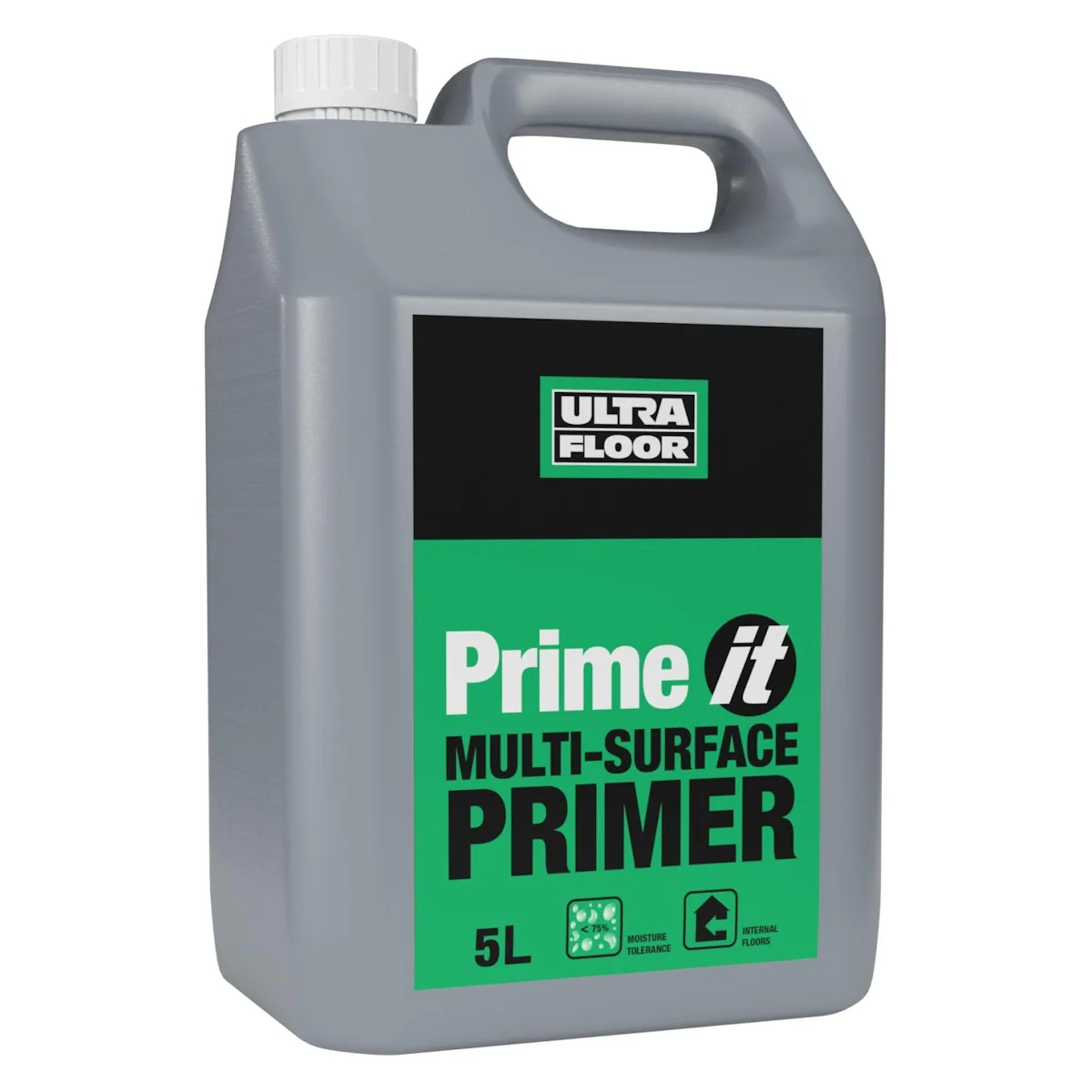
UltraFloor Prime IT Multi-Surface Primer 5L | Porous & Non-Porous Substrates
HomeStore

UltraFloor Prime IT Multi-Surface Primer 5L | Porous & Non-Porous Substrates

UltraFloor Prime IT Multi-Surface Primer 5L | Porous & Non-Porous Substrates

UltraFloor Prime IT Multi-Surface Primer (MSP) is a moisture-tolerant, water-based acrylic polymer primer, sealer and bonding aid for use on both porous and non-porous subfloors prior to the application of smoothing underlayments. Prime IT MSP stabilises and consolidates the substrate surface, controls absorbency and promotes adhesion — preventing the pinholes, poor bonding and uneven curing that result from applying underlayment to an unprimed or incorrectly primed floor. A single product handles the full substrate range: concrete, sand/cement screed, anhydrite, plywood, existing underlayment, epoxy DPMs, power-floated concrete, tiles, terrazzo, steel, asphalt, painted floors and adhesive residues. The pink pigmentation dries to a clearly visible pink film — confirming coverage and indicating when the surface is ready to receive the next product. Also functions as a curing agent for cementitious materials when diluted 1:1 and applied by spray. Coverage: up to 200m² per 5L at 3:1 dilution on porous substrates. Ready to receive underlayment in 1–2 hours at 20°C. 12-month shelf life.

Porous
& Non-Porous
200m²
per 5L at 3:1
1–2 hrs
Ready to Receive
Pink
Dry Film
Water
Based
12 mths
Shelf Life
⚠ Moisture Check — BS 8203: All subfloors must be tested with a hygrometer to confirm RH is below 75% RH (BS 8203) before priming. Where RH exceeds this level, or where the floor construction does not incorporate a DPC, apply UltraFloor DPM IT or Suppress IT before Prime IT MSP. Prime IT MSP is moisture tolerant but is not a damp proof membrane.
Coverage Rates — 5 Litre Container
Use Dilution Coverage per 5L (smooth subfloor) Coverage per Litre
Porous — 1st coat 3:1 with water 140–200m² 28–40m²
Porous — 2nd coat 1:1 with water 70–100m² 14–20m²
Non-porous — single coat Neat (undiluted) 25–50m² 5–10m²
Curing agent 1:1 with water (spray only) 30–40m² 6–8m²

Coverage rates are for smooth subfloors. Rough, open-textured or very absorbent substrates will reduce coverage — increase quantity allowance accordingly.

Substrate Application Guide — Official UltraFloor Datasheet
Substrate Treatment Dilution — Coat 1 Dilution — Coat 2 Dry Time per Coat
Power floated concrete Non-porous — mechanically abrade (shot-blast or scarify) first Neat No 2nd coat needed 1–2 hrs
Tamped / pan floated concrete Porous — remove laitance mechanically 3:1 with water 1:1 with water 1–2 hrs each
Sand/cement screed Porous — repair weak/friable areas first 3:1 with water 1:1 with water 1–2 hrs each
Calcium sulphate / anhydrite screed Porous — remove laitance; RH <75% required 3:1 with water (dry overnight) 1:1 with water Overnight / 1–2 hrs
Existing smoothing underlayment Porous — remove adhesive residues first 3:1 with water 1:1 with water 1–2 hrs each
Surface DPM / MVS Non-porous — apply within 12 hrs of DPM Neat No 2nd coat needed 1–2 hrs
Flooring grade plywood Usually porous — seal edges and underside first 3:1 with water (dense veneers: neat) None usually required 1–2 hrs
Cementitious backer boards Low absorbency 5:1 (5 parts water to 1 part primer) No 2nd coat needed Full dry
Flooring grade asphalt New: 7 day cure + degrease. Existing: check cracks Neat No 2nd coat needed 1–2 hrs
Terrazzo / ceramic tiles / granolithic Non-porous — mechanically abrade (STG + diamond disc) Neat No 2nd coat needed 1–2 hrs
Non-flexing steel floors Internal rust-proof only — mechanically abrade (STG or shot-blast) Neat No 2nd coat needed 1–2 hrs
PU / epoxy resin / painted floors Mechanically abrade (STG or shot-blast) to key surface Neat No 2nd coat needed 1–2 hrs
Existing adhesive residues Moisture-tolerant adhesives only — remove friable/loose material, leave thin film Neat No 2nd coat needed 1–2 hrs

Source: UltraFloor Prime IT MSP Technical Datasheet (Vers. 03.06.2023 — Instarmac Group). Always refer to the current datasheet at instarmac.co.uk for the latest guidance. Subfloor RH must be below 75% RH (BS 8203) before priming unless a DPM is applied first. Minimum substrate temperature 5°C throughout application.

Key Features
Primer, Sealer and Bonding Aid in One — Works on Porous and Non-Porous Surfaces
Most primers are formulated for either porous or non-porous substrates — not both. Prime IT MSP is specifically engineered as a single product that handles the full range of substrates encountered in floor preparation: porous surfaces (concrete, sand/cement screed, anhydrite, plywood, existing underlayment) and non-porous surfaces (power floated concrete, epoxy DPMs, steel, tiles, asphalt, existing adhesive films). The dilution rate changes to match the substrate — see the application guide table below. This means one product on the van, one product on the invoice, and no risk of reaching for the wrong primer on a mixed-substrate job.
Porous substratesNon-porous substratesOne product, both types
Pink Pigmentation — See Your Coverage as You Apply
Prime IT MSP is a pink liquid that dries to a clearly visible pink film. This is not a cosmetic feature — it is a practical quality control tool. The pink colour makes it immediately obvious whether a coat has been applied to the entire surface or whether areas have been missed. It also confirms when the primer has dried to the correct film state and is ready to receive the smoothing underlayment — a pink film means ready; a wet or patchy surface means wait. There is no guesswork and no inadvertent application of underlayment over a wet primer, which would compromise adhesion.
Pink liquid — pink dry filmVisual coverage checkConfirms dry state
Stabilises and Consolidates the Substrate — Reduces Absorbency for Better Underlayment Performance
The primary function of any primer before a smoothing underlayment is to control the substrate's absorbency. On highly porous surfaces (raw concrete, sand/cement screed), an unprimed substrate draws moisture out of the fresh underlayment too quickly — the underlayment skins over on the surface while still wet beneath, trapping air, causing pinholes, and reducing the bond strength and surface hardness of the cured underlayment. Prime IT MSP penetrates the surface, consolidates friable material and creates a controlled, reduced-absorbency skin so the underlayment cures evenly throughout its depth.
Controls absorbencyPrevents pinholesEven underlayment cure
Maximises Interlayer Adhesion — Recommended Between Multilayer Builds
On projects requiring two or more layers of smoothing underlayment — such as build-ups over 6mm, or where a first layer needs topping to achieve a flat finish — Prime IT MSP is recommended between each layer as well as before the first. Applying primer between layers minimises pinholes at the interface and maximises the adhesive bond between the cured lower layer and the fresh upper pour. Without interlayer primer, the cured underlayment acts as a low-porosity surface that the fresh layer may not bond to adequately.
Between underlayment layersMaximises interlayer bondReduces pinholes
Moisture Tolerant — Can Be Applied Over Slightly Damp Substrates
Prime IT MSP is described by UltraFloor as moisture tolerant. This means it can be applied where the substrate carries a degree of residual moisture, provided the subfloor RH is within the acceptable range (below 75% RH per BS 8203) and a DPM has been applied where required. It should not be confused with a damp proof membrane — it is not a vapour barrier. Where the subfloor RH exceeds 75% RH or where no DPC exists in the floor design, UltraFloor DPM IT or Suppress IT must be applied first.
Moisture tolerantNot a DPM — RH <75% requiredUse DPM IT if RH >75%
Also Functions as a Curing Agent for Cementitious Products
Prime IT MSP has a secondary function as a curing agent for cementitious-based products (concrete, screed). Diluted 1:1 with water and applied by spray bottle (8–10 inches from the surface) immediately after laying a cementitious material, it forms a thin even film that slows surface moisture evaporation — preventing the rapid surface drying that causes surface cracking, crazing and dustiness in concrete and screed. When used as a curing agent it must be applied by spray only — not by brush or roller — and must not be mixed with other curing compounds.
Curing agent functionSpray only — 1:1 dilutionNot with other curing agents
Up to 200m² per 5L — Excellent Coverage on Porous Surfaces
At 3:1 dilution on porous substrates, a 5L container covers 140–200m² of smooth floor area — a genuinely high yield for a first primer coat. The 1:1 second coat on porous surfaces covers a further 70–100m² from the same container. On non-porous surfaces (applied neat), a 5L container covers 25–50m². Coverage will reduce on rough or very absorbent surfaces — adjust quantities accordingly.
140–200m² at 3:125–50m² neat5L container
Ready to Receive Underlayment in 1–2 Hours at 20°C
Under good drying conditions (20°C, normal humidity), primed surfaces are ready to receive smoothing underlayments in 1–2 hours. The pink film confirms readiness — do not proceed until the primer is fully dry. On non-porous substrates the dried primer exhibits a light tack; the underlayment must be applied within 36 hours of the primer drying and ambient temperature must remain above 10°C throughout. On calcium sulphate screeds the first coat may need to dry overnight.
1–2 hrs at 20°CLight tack on non-porousApply within 36 hrs
Water-Based — Easy Clean-Up, Low Odour
Prime IT MSP is water-based. Tools and equipment are cleaned with water immediately after use — no solvents required. Low odour compared with solvent-based alternatives. Store in the original container at 5–30°C, out of direct sunlight and away from frost. Shelf life: 12 months from manufacture. Manufactured by Instarmac Group plc, Tamworth — BS EN ISO 9001, ISO 14001 and ISO 45001 certified.
Water-basedNo solvents12-month shelf life5–30°C storage
Technical Specifications
Product
Product Type Water-based acrylic polymer primer, sealer and bonding aid
Colour Pink liquid — dries to pink film
Pack Size 5 litres
Performance
Coverage — Porous 1st coat (3:1 dilution) 140–200m² per 5L on smooth subfloor
Coverage — Porous 2nd coat (1:1 dilution) 70–100m² per 5L on smooth subfloor
Coverage — Non-porous neat 25–50m² per 5L on smooth subfloor
Coverage — Curing agent (1:1 spray) 30–40m² per 5L
Drying Time (ready to receive underlayment) 1–2 hours at 20°C
Tack-free (non-porous) Light tack — apply underlayment within 36 hours
Application
Porous substrates Brush or roller — 2 coats: 3:1 then 1:1 dilution
Non-porous substrates Brush or roller — 1 coat neat
Curing agent Spray bottle only at 1:1 dilution — 8–10 inches from surface
Minimum substrate temperature 5°C before, during and after application
Ambient temperature during drying (non-porous) Maintain above 10°C
Subfloor Requirements
Moisture (BS 8203) RH <75% — use DPM IT or Suppress IT if RH exceeds this
Surface condition Sound, stable, dry, dust-free, free of oils/grease/laitance
Storage and Shelf Life
Storage 5°C to 30°C — original container, out of direct sunlight and frost
Shelf Life 12 months from manufacture
Quality Assurance
Manufacturer Instarmac Group plc, Birch Coppice Business Park, Tamworth, Staffordshire
Certification BS EN ISO 9001, ISO 14001, ISO 45001
NBS Source Registered
Frequently Asked Questions
Do I need to prime before applying a smoothing underlayment?
Yes, in virtually all cases. Without primer, highly porous substrates pull moisture from the fresh underlayment too quickly — causing pinholes, poor surface hardness and weak adhesion. On non-porous surfaces, primer provides the tackified bonding surface that allows the underlayment to grip rather than sliding or debonding on the smooth substrate. Skipping primer is one of the most common causes of underlayment failure.
What is the correct dilution for my subfloor?
The datasheet specifies dilution by substrate type: Power floated concrete, epoxy DPMs, steel, tiles, asphalt: neat (undiluted), single coat. Concrete (tamped/pan floated), sand/cement screed, anhydrite, existing underlayment: two coats — first at 3:1 (3 parts water to 1 part primer), second at 1:1. Plywood: usually 3:1, but neat for dense low-absorbency veneers. Cementitious backer boards: 5:1 (5 parts water to 1 part primer), single coat. Always refer to the substrate guide table on this page and the current UltraFloor datasheet.
Can I use Prime IT MSP as a damp proof membrane?
No — Prime IT MSP is not a damp proof membrane. It is moisture-tolerant but not a vapour barrier. Before applying Prime IT MSP, the subfloor must test below 75% RH (BS 8203). Where RH exceeds 75% or where the floor construction lacks a DPC, UltraFloor DPM IT or UltraFloor Suppress IT must be applied first.
How do I know when the primer is dry and ready for underlayment?
Wait for the primer to dry to a pink film. The pink pigmentation makes this easy to confirm visually — any wet or translucent areas are not yet ready. Under good conditions (20°C, normal humidity) this takes 1–2 hours. On non-porous substrates the dried primer will have a light tack — this is normal and correct. Once dry, the underlayment must be applied within 36 hours, and ambient temperature must remain above 10°C.
Can I use Prime IT MSP between coats of smoothing underlayment?
Yes — and UltraFloor specifically recommends it for multilayer builds. Applying Prime IT MSP between the first and second underlayment layers minimises pinholes at the interface and maximises interlayer adhesion. Without interlayer primer, the cured first layer acts as a low-porosity surface that the second layer may not bond to reliably.
Related Products
UltraFloor DPM IT
Damp proof membrane — apply first if subfloor RH >75%
UltraFloor Suppress IT
Moisture vapour suppressant primer for high RH subfloors
UltraFloor Level IT Two
Fast-drying smoothing underlayment — apply after Prime IT MSP
HeatBoard ONE Routed Chipboard Panels
UFH panel system — subfloor prep needed before underlayment
$82.33
UltraFloor Prime IT Multi-Surface Primer 5L | Porous & Non-Porous Substrates
$82.33

UltraFloor Prime IT Multi-Surface Primer 5L | Porous & Non-Porous Substrates

UltraFloor Prime IT Multi-Surface Primer (MSP) is a moisture-tolerant, water-based acrylic polymer primer, sealer and bonding aid for use on both porous and non-porous subfloors prior to the application of smoothing underlayments. Prime IT MSP stabilises and consolidates the substrate surface, controls absorbency and promotes adhesion — preventing the pinholes, poor bonding and uneven curing that result from applying underlayment to an unprimed or incorrectly primed floor. A single product handles the full substrate range: concrete, sand/cement screed, anhydrite, plywood, existing underlayment, epoxy DPMs, power-floated concrete, tiles, terrazzo, steel, asphalt, painted floors and adhesive residues. The pink pigmentation dries to a clearly visible pink film — confirming coverage and indicating when the surface is ready to receive the next product. Also functions as a curing agent for cementitious materials when diluted 1:1 and applied by spray. Coverage: up to 200m² per 5L at 3:1 dilution on porous substrates. Ready to receive underlayment in 1–2 hours at 20°C. 12-month shelf life.

Porous
& Non-Porous
200m²
per 5L at 3:1
1–2 hrs
Ready to Receive
Pink
Dry Film
Water
Based
12 mths
Shelf Life
⚠ Moisture Check — BS 8203: All subfloors must be tested with a hygrometer to confirm RH is below 75% RH (BS 8203) before priming. Where RH exceeds this level, or where the floor construction does not incorporate a DPC, apply UltraFloor DPM IT or Suppress IT before Prime IT MSP. Prime IT MSP is moisture tolerant but is not a damp proof membrane.
Coverage Rates — 5 Litre Container
Use Dilution Coverage per 5L (smooth subfloor) Coverage per Litre
Porous — 1st coat 3:1 with water 140–200m² 28–40m²
Porous — 2nd coat 1:1 with water 70–100m² 14–20m²
Non-porous — single coat Neat (undiluted) 25–50m² 5–10m²
Curing agent 1:1 with water (spray only) 30–40m² 6–8m²

Coverage rates are for smooth subfloors. Rough, open-textured or very absorbent substrates will reduce coverage — increase quantity allowance accordingly.

Substrate Application Guide — Official UltraFloor Datasheet
Substrate Treatment Dilution — Coat 1 Dilution — Coat 2 Dry Time per Coat
Power floated concrete Non-porous — mechanically abrade (shot-blast or scarify) first Neat No 2nd coat needed 1–2 hrs
Tamped / pan floated concrete Porous — remove laitance mechanically 3:1 with water 1:1 with water 1–2 hrs each
Sand/cement screed Porous — repair weak/friable areas first 3:1 with water 1:1 with water 1–2 hrs each
Calcium sulphate / anhydrite screed Porous — remove laitance; RH <75% required 3:1 with water (dry overnight) 1:1 with water Overnight / 1–2 hrs
Existing smoothing underlayment Porous — remove adhesive residues first 3:1 with water 1:1 with water 1–2 hrs each
Surface DPM / MVS Non-porous — apply within 12 hrs of DPM Neat No 2nd coat needed 1–2 hrs
Flooring grade plywood Usually porous — seal edges and underside first 3:1 with water (dense veneers: neat) None usually required 1–2 hrs
Cementitious backer boards Low absorbency 5:1 (5 parts water to 1 part primer) No 2nd coat needed Full dry
Flooring grade asphalt New: 7 day cure + degrease. Existing: check cracks Neat No 2nd coat needed 1–2 hrs
Terrazzo / ceramic tiles / granolithic Non-porous — mechanically abrade (STG + diamond disc) Neat No 2nd coat needed 1–2 hrs
Non-flexing steel floors Internal rust-proof only — mechanically abrade (STG or shot-blast) Neat No 2nd coat needed 1–2 hrs
PU / epoxy resin / painted floors Mechanically abrade (STG or shot-blast) to key surface Neat No 2nd coat needed 1–2 hrs
Existing adhesive residues Moisture-tolerant adhesives only — remove friable/loose material, leave thin film Neat No 2nd coat needed 1–2 hrs

Source: UltraFloor Prime IT MSP Technical Datasheet (Vers. 03.06.2023 — Instarmac Group). Always refer to the current datasheet at instarmac.co.uk for the latest guidance. Subfloor RH must be below 75% RH (BS 8203) before priming unless a DPM is applied first. Minimum substrate temperature 5°C throughout application.

Key Features
Primer, Sealer and Bonding Aid in One — Works on Porous and Non-Porous Surfaces
Most primers are formulated for either porous or non-porous substrates — not both. Prime IT MSP is specifically engineered as a single product that handles the full range of substrates encountered in floor preparation: porous surfaces (concrete, sand/cement screed, anhydrite, plywood, existing underlayment) and non-porous surfaces (power floated concrete, epoxy DPMs, steel, tiles, asphalt, existing adhesive films). The dilution rate changes to match the substrate — see the application guide table below. This means one product on the van, one product on the invoice, and no risk of reaching for the wrong primer on a mixed-substrate job.
Porous substratesNon-porous substratesOne product, both types
Pink Pigmentation — See Your Coverage as You Apply
Prime IT MSP is a pink liquid that dries to a clearly visible pink film. This is not a cosmetic feature — it is a practical quality control tool. The pink colour makes it immediately obvious whether a coat has been applied to the entire surface or whether areas have been missed. It also confirms when the primer has dried to the correct film state and is ready to receive the smoothing underlayment — a pink film means ready; a wet or patchy surface means wait. There is no guesswork and no inadvertent application of underlayment over a wet primer, which would compromise adhesion.
Pink liquid — pink dry filmVisual coverage checkConfirms dry state
Stabilises and Consolidates the Substrate — Reduces Absorbency for Better Underlayment Performance
The primary function of any primer before a smoothing underlayment is to control the substrate's absorbency. On highly porous surfaces (raw concrete, sand/cement screed), an unprimed substrate draws moisture out of the fresh underlayment too quickly — the underlayment skins over on the surface while still wet beneath, trapping air, causing pinholes, and reducing the bond strength and surface hardness of the cured underlayment. Prime IT MSP penetrates the surface, consolidates friable material and creates a controlled, reduced-absorbency skin so the underlayment cures evenly throughout its depth.
Controls absorbencyPrevents pinholesEven underlayment cure
Maximises Interlayer Adhesion — Recommended Between Multilayer Builds
On projects requiring two or more layers of smoothing underlayment — such as build-ups over 6mm, or where a first layer needs topping to achieve a flat finish — Prime IT MSP is recommended between each layer as well as before the first. Applying primer between layers minimises pinholes at the interface and maximises the adhesive bond between the cured lower layer and the fresh upper pour. Without interlayer primer, the cured underlayment acts as a low-porosity surface that the fresh layer may not bond to adequately.
Between underlayment layersMaximises interlayer bondReduces pinholes
Moisture Tolerant — Can Be Applied Over Slightly Damp Substrates
Prime IT MSP is described by UltraFloor as moisture tolerant. This means it can be applied where the substrate carries a degree of residual moisture, provided the subfloor RH is within the acceptable range (below 75% RH per BS 8203) and a DPM has been applied where required. It should not be confused with a damp proof membrane — it is not a vapour barrier. Where the subfloor RH exceeds 75% RH or where no DPC exists in the floor design, UltraFloor DPM IT or Suppress IT must be applied first.
Moisture tolerantNot a DPM — RH <75% requiredUse DPM IT if RH >75%
Also Functions as a Curing Agent for Cementitious Products
Prime IT MSP has a secondary function as a curing agent for cementitious-based products (concrete, screed). Diluted 1:1 with water and applied by spray bottle (8–10 inches from the surface) immediately after laying a cementitious material, it forms a thin even film that slows surface moisture evaporation — preventing the rapid surface drying that causes surface cracking, crazing and dustiness in concrete and screed. When used as a curing agent it must be applied by spray only — not by brush or roller — and must not be mixed with other curing compounds.
Curing agent functionSpray only — 1:1 dilutionNot with other curing agents
Up to 200m² per 5L — Excellent Coverage on Porous Surfaces
At 3:1 dilution on porous substrates, a 5L container covers 140–200m² of smooth floor area — a genuinely high yield for a first primer coat. The 1:1 second coat on porous surfaces covers a further 70–100m² from the same container. On non-porous surfaces (applied neat), a 5L container covers 25–50m². Coverage will reduce on rough or very absorbent surfaces — adjust quantities accordingly.
140–200m² at 3:125–50m² neat5L container
Ready to Receive Underlayment in 1–2 Hours at 20°C
Under good drying conditions (20°C, normal humidity), primed surfaces are ready to receive smoothing underlayments in 1–2 hours. The pink film confirms readiness — do not proceed until the primer is fully dry. On non-porous substrates the dried primer exhibits a light tack; the underlayment must be applied within 36 hours of the primer drying and ambient temperature must remain above 10°C throughout. On calcium sulphate screeds the first coat may need to dry overnight.
1–2 hrs at 20°CLight tack on non-porousApply within 36 hrs
Water-Based — Easy Clean-Up, Low Odour
Prime IT MSP is water-based. Tools and equipment are cleaned with water immediately after use — no solvents required. Low odour compared with solvent-based alternatives. Store in the original container at 5–30°C, out of direct sunlight and away from frost. Shelf life: 12 months from manufacture. Manufactured by Instarmac Group plc, Tamworth — BS EN ISO 9001, ISO 14001 and ISO 45001 certified.
Water-basedNo solvents12-month shelf life5–30°C storage
Technical Specifications
Product
Product Type Water-based acrylic polymer primer, sealer and bonding aid
Colour Pink liquid — dries to pink film
Pack Size 5 litres
Performance
Coverage — Porous 1st coat (3:1 dilution) 140–200m² per 5L on smooth subfloor
Coverage — Porous 2nd coat (1:1 dilution) 70–100m² per 5L on smooth subfloor
Coverage — Non-porous neat 25–50m² per 5L on smooth subfloor
Coverage — Curing agent (1:1 spray) 30–40m² per 5L
Drying Time (ready to receive underlayment) 1–2 hours at 20°C
Tack-free (non-porous) Light tack — apply underlayment within 36 hours
Application
Porous substrates Brush or roller — 2 coats: 3:1 then 1:1 dilution
Non-porous substrates Brush or roller — 1 coat neat
Curing agent Spray bottle only at 1:1 dilution — 8–10 inches from surface
Minimum substrate temperature 5°C before, during and after application
Ambient temperature during drying (non-porous) Maintain above 10°C
Subfloor Requirements
Moisture (BS 8203) RH <75% — use DPM IT or Suppress IT if RH exceeds this
Surface condition Sound, stable, dry, dust-free, free of oils/grease/laitance
Storage and Shelf Life
Storage 5°C to 30°C — original container, out of direct sunlight and frost
Shelf Life 12 months from manufacture
Quality Assurance
Manufacturer Instarmac Group plc, Birch Coppice Business Park, Tamworth, Staffordshire
Certification BS EN ISO 9001, ISO 14001, ISO 45001
NBS Source Registered
Frequently Asked Questions
Do I need to prime before applying a smoothing underlayment?
Yes, in virtually all cases. Without primer, highly porous substrates pull moisture from the fresh underlayment too quickly — causing pinholes, poor surface hardness and weak adhesion. On non-porous surfaces, primer provides the tackified bonding surface that allows the underlayment to grip rather than sliding or debonding on the smooth substrate. Skipping primer is one of the most common causes of underlayment failure.
What is the correct dilution for my subfloor?
The datasheet specifies dilution by substrate type: Power floated concrete, epoxy DPMs, steel, tiles, asphalt: neat (undiluted), single coat. Concrete (tamped/pan floated), sand/cement screed, anhydrite, existing underlayment: two coats — first at 3:1 (3 parts water to 1 part primer), second at 1:1. Plywood: usually 3:1, but neat for dense low-absorbency veneers. Cementitious backer boards: 5:1 (5 parts water to 1 part primer), single coat. Always refer to the substrate guide table on this page and the current UltraFloor datasheet.
Can I use Prime IT MSP as a damp proof membrane?
No — Prime IT MSP is not a damp proof membrane. It is moisture-tolerant but not a vapour barrier. Before applying Prime IT MSP, the subfloor must test below 75% RH (BS 8203). Where RH exceeds 75% or where the floor construction lacks a DPC, UltraFloor DPM IT or UltraFloor Suppress IT must be applied first.
How do I know when the primer is dry and ready for underlayment?
Wait for the primer to dry to a pink film. The pink pigmentation makes this easy to confirm visually — any wet or translucent areas are not yet ready. Under good conditions (20°C, normal humidity) this takes 1–2 hours. On non-porous substrates the dried primer will have a light tack — this is normal and correct. Once dry, the underlayment must be applied within 36 hours, and ambient temperature must remain above 10°C.
Can I use Prime IT MSP between coats of smoothing underlayment?
Yes — and UltraFloor specifically recommends it for multilayer builds. Applying Prime IT MSP between the first and second underlayment layers minimises pinholes at the interface and maximises interlayer adhesion. Without interlayer primer, the cured first layer acts as a low-porosity surface that the second layer may not bond to reliably.
Related Products
UltraFloor DPM IT
Damp proof membrane — apply first if subfloor RH >75%
UltraFloor Suppress IT
Moisture vapour suppressant primer for high RH subfloors
UltraFloor Level IT Two
Fast-drying smoothing underlayment — apply after Prime IT MSP
HeatBoard ONE Routed Chipboard Panels
UFH panel system — subfloor prep needed before underlayment

Product Information

Shipping & Returns

Description

UltraFloor Prime IT Multi-Surface Primer (MSP) is a moisture-tolerant, water-based acrylic polymer primer, sealer and bonding aid for use on both porous and non-porous subfloors prior to the application of smoothing underlayments. Prime IT MSP stabilises and consolidates the substrate surface, controls absorbency and promotes adhesion — preventing the pinholes, poor bonding and uneven curing that result from applying underlayment to an unprimed or incorrectly primed floor. A single product handles the full substrate range: concrete, sand/cement screed, anhydrite, plywood, existing underlayment, epoxy DPMs, power-floated concrete, tiles, terrazzo, steel, asphalt, painted floors and adhesive residues. The pink pigmentation dries to a clearly visible pink film — confirming coverage and indicating when the surface is ready to receive the next product. Also functions as a curing agent for cementitious materials when diluted 1:1 and applied by spray. Coverage: up to 200m² per 5L at 3:1 dilution on porous substrates. Ready to receive underlayment in 1–2 hours at 20°C. 12-month shelf life.

Porous
& Non-Porous
200m²
per 5L at 3:1
1–2 hrs
Ready to Receive
Pink
Dry Film
Water
Based
12 mths
Shelf Life
⚠ Moisture Check — BS 8203: All subfloors must be tested with a hygrometer to confirm RH is below 75% RH (BS 8203) before priming. Where RH exceeds this level, or where the floor construction does not incorporate a DPC, apply UltraFloor DPM IT or Suppress IT before Prime IT MSP. Prime IT MSP is moisture tolerant but is not a damp proof membrane.
Coverage Rates — 5 Litre Container
Use Dilution Coverage per 5L (smooth subfloor) Coverage per Litre
Porous — 1st coat 3:1 with water 140–200m² 28–40m²
Porous — 2nd coat 1:1 with water 70–100m² 14–20m²
Non-porous — single coat Neat (undiluted) 25–50m² 5–10m²
Curing agent 1:1 with water (spray only) 30–40m² 6–8m²

Coverage rates are for smooth subfloors. Rough, open-textured or very absorbent substrates will reduce coverage — increase quantity allowance accordingly.

Substrate Application Guide — Official UltraFloor Datasheet
Substrate Treatment Dilution — Coat 1 Dilution — Coat 2 Dry Time per Coat
Power floated concrete Non-porous — mechanically abrade (shot-blast or scarify) first Neat No 2nd coat needed 1–2 hrs
Tamped / pan floated concrete Porous — remove laitance mechanically 3:1 with water 1:1 with water 1–2 hrs each
Sand/cement screed Porous — repair weak/friable areas first 3:1 with water 1:1 with water 1–2 hrs each
Calcium sulphate / anhydrite screed Porous — remove laitance; RH <75% required 3:1 with water (dry overnight) 1:1 with water Overnight / 1–2 hrs
Existing smoothing underlayment Porous — remove adhesive residues first 3:1 with water 1:1 with water 1–2 hrs each
Surface DPM / MVS Non-porous — apply within 12 hrs of DPM Neat No 2nd coat needed 1–2 hrs
Flooring grade plywood Usually porous — seal edges and underside first 3:1 with water (dense veneers: neat) None usually required 1–2 hrs
Cementitious backer boards Low absorbency 5:1 (5 parts water to 1 part primer) No 2nd coat needed Full dry
Flooring grade asphalt New: 7 day cure + degrease. Existing: check cracks Neat No 2nd coat needed 1–2 hrs
Terrazzo / ceramic tiles / granolithic Non-porous — mechanically abrade (STG + diamond disc) Neat No 2nd coat needed 1–2 hrs
Non-flexing steel floors Internal rust-proof only — mechanically abrade (STG or shot-blast) Neat No 2nd coat needed 1–2 hrs
PU / epoxy resin / painted floors Mechanically abrade (STG or shot-blast) to key surface Neat No 2nd coat needed 1–2 hrs
Existing adhesive residues Moisture-tolerant adhesives only — remove friable/loose material, leave thin film Neat No 2nd coat needed 1–2 hrs

Source: UltraFloor Prime IT MSP Technical Datasheet (Vers. 03.06.2023 — Instarmac Group). Always refer to the current datasheet at instarmac.co.uk for the latest guidance. Subfloor RH must be below 75% RH (BS 8203) before priming unless a DPM is applied first. Minimum substrate temperature 5°C throughout application.

Key Features
Primer, Sealer and Bonding Aid in One — Works on Porous and Non-Porous Surfaces
Most primers are formulated for either porous or non-porous substrates — not both. Prime IT MSP is specifically engineered as a single product that handles the full range of substrates encountered in floor preparation: porous surfaces (concrete, sand/cement screed, anhydrite, plywood, existing underlayment) and non-porous surfaces (power floated concrete, epoxy DPMs, steel, tiles, asphalt, existing adhesive films). The dilution rate changes to match the substrate — see the application guide table below. This means one product on the van, one product on the invoice, and no risk of reaching for the wrong primer on a mixed-substrate job.
Porous substratesNon-porous substratesOne product, both types
Pink Pigmentation — See Your Coverage as You Apply
Prime IT MSP is a pink liquid that dries to a clearly visible pink film. This is not a cosmetic feature — it is a practical quality control tool. The pink colour makes it immediately obvious whether a coat has been applied to the entire surface or whether areas have been missed. It also confirms when the primer has dried to the correct film state and is ready to receive the smoothing underlayment — a pink film means ready; a wet or patchy surface means wait. There is no guesswork and no inadvertent application of underlayment over a wet primer, which would compromise adhesion.
Pink liquid — pink dry filmVisual coverage checkConfirms dry state
Stabilises and Consolidates the Substrate — Reduces Absorbency for Better Underlayment Performance
The primary function of any primer before a smoothing underlayment is to control the substrate's absorbency. On highly porous surfaces (raw concrete, sand/cement screed), an unprimed substrate draws moisture out of the fresh underlayment too quickly — the underlayment skins over on the surface while still wet beneath, trapping air, causing pinholes, and reducing the bond strength and surface hardness of the cured underlayment. Prime IT MSP penetrates the surface, consolidates friable material and creates a controlled, reduced-absorbency skin so the underlayment cures evenly throughout its depth.
Controls absorbencyPrevents pinholesEven underlayment cure
Maximises Interlayer Adhesion — Recommended Between Multilayer Builds
On projects requiring two or more layers of smoothing underlayment — such as build-ups over 6mm, or where a first layer needs topping to achieve a flat finish — Prime IT MSP is recommended between each layer as well as before the first. Applying primer between layers minimises pinholes at the interface and maximises the adhesive bond between the cured lower layer and the fresh upper pour. Without interlayer primer, the cured underlayment acts as a low-porosity surface that the fresh layer may not bond to adequately.
Between underlayment layersMaximises interlayer bondReduces pinholes
Moisture Tolerant — Can Be Applied Over Slightly Damp Substrates
Prime IT MSP is described by UltraFloor as moisture tolerant. This means it can be applied where the substrate carries a degree of residual moisture, provided the subfloor RH is within the acceptable range (below 75% RH per BS 8203) and a DPM has been applied where required. It should not be confused with a damp proof membrane — it is not a vapour barrier. Where the subfloor RH exceeds 75% RH or where no DPC exists in the floor design, UltraFloor DPM IT or Suppress IT must be applied first.
Moisture tolerantNot a DPM — RH <75% requiredUse DPM IT if RH >75%
Also Functions as a Curing Agent for Cementitious Products
Prime IT MSP has a secondary function as a curing agent for cementitious-based products (concrete, screed). Diluted 1:1 with water and applied by spray bottle (8–10 inches from the surface) immediately after laying a cementitious material, it forms a thin even film that slows surface moisture evaporation — preventing the rapid surface drying that causes surface cracking, crazing and dustiness in concrete and screed. When used as a curing agent it must be applied by spray only — not by brush or roller — and must not be mixed with other curing compounds.
Curing agent functionSpray only — 1:1 dilutionNot with other curing agents
Up to 200m² per 5L — Excellent Coverage on Porous Surfaces
At 3:1 dilution on porous substrates, a 5L container covers 140–200m² of smooth floor area — a genuinely high yield for a first primer coat. The 1:1 second coat on porous surfaces covers a further 70–100m² from the same container. On non-porous surfaces (applied neat), a 5L container covers 25–50m². Coverage will reduce on rough or very absorbent surfaces — adjust quantities accordingly.
140–200m² at 3:125–50m² neat5L container
Ready to Receive Underlayment in 1–2 Hours at 20°C
Under good drying conditions (20°C, normal humidity), primed surfaces are ready to receive smoothing underlayments in 1–2 hours. The pink film confirms readiness — do not proceed until the primer is fully dry. On non-porous substrates the dried primer exhibits a light tack; the underlayment must be applied within 36 hours of the primer drying and ambient temperature must remain above 10°C throughout. On calcium sulphate screeds the first coat may need to dry overnight.
1–2 hrs at 20°CLight tack on non-porousApply within 36 hrs
Water-Based — Easy Clean-Up, Low Odour
Prime IT MSP is water-based. Tools and equipment are cleaned with water immediately after use — no solvents required. Low odour compared with solvent-based alternatives. Store in the original container at 5–30°C, out of direct sunlight and away from frost. Shelf life: 12 months from manufacture. Manufactured by Instarmac Group plc, Tamworth — BS EN ISO 9001, ISO 14001 and ISO 45001 certified.
Water-basedNo solvents12-month shelf life5–30°C storage
Technical Specifications
Product
Product Type Water-based acrylic polymer primer, sealer and bonding aid
Colour Pink liquid — dries to pink film
Pack Size 5 litres
Performance
Coverage — Porous 1st coat (3:1 dilution) 140–200m² per 5L on smooth subfloor
Coverage — Porous 2nd coat (1:1 dilution) 70–100m² per 5L on smooth subfloor
Coverage — Non-porous neat 25–50m² per 5L on smooth subfloor
Coverage — Curing agent (1:1 spray) 30–40m² per 5L
Drying Time (ready to receive underlayment) 1–2 hours at 20°C
Tack-free (non-porous) Light tack — apply underlayment within 36 hours
Application
Porous substrates Brush or roller — 2 coats: 3:1 then 1:1 dilution
Non-porous substrates Brush or roller — 1 coat neat
Curing agent Spray bottle only at 1:1 dilution — 8–10 inches from surface
Minimum substrate temperature 5°C before, during and after application
Ambient temperature during drying (non-porous) Maintain above 10°C
Subfloor Requirements
Moisture (BS 8203) RH <75% — use DPM IT or Suppress IT if RH exceeds this
Surface condition Sound, stable, dry, dust-free, free of oils/grease/laitance
Storage and Shelf Life
Storage 5°C to 30°C — original container, out of direct sunlight and frost
Shelf Life 12 months from manufacture
Quality Assurance
Manufacturer Instarmac Group plc, Birch Coppice Business Park, Tamworth, Staffordshire
Certification BS EN ISO 9001, ISO 14001, ISO 45001
NBS Source Registered
Frequently Asked Questions
Do I need to prime before applying a smoothing underlayment?
Yes, in virtually all cases. Without primer, highly porous substrates pull moisture from the fresh underlayment too quickly — causing pinholes, poor surface hardness and weak adhesion. On non-porous surfaces, primer provides the tackified bonding surface that allows the underlayment to grip rather than sliding or debonding on the smooth substrate. Skipping primer is one of the most common causes of underlayment failure.
What is the correct dilution for my subfloor?
The datasheet specifies dilution by substrate type: Power floated concrete, epoxy DPMs, steel, tiles, asphalt: neat (undiluted), single coat. Concrete (tamped/pan floated), sand/cement screed, anhydrite, existing underlayment: two coats — first at 3:1 (3 parts water to 1 part primer), second at 1:1. Plywood: usually 3:1, but neat for dense low-absorbency veneers. Cementitious backer boards: 5:1 (5 parts water to 1 part primer), single coat. Always refer to the substrate guide table on this page and the current UltraFloor datasheet.
Can I use Prime IT MSP as a damp proof membrane?
No — Prime IT MSP is not a damp proof membrane. It is moisture-tolerant but not a vapour barrier. Before applying Prime IT MSP, the subfloor must test below 75% RH (BS 8203). Where RH exceeds 75% or where the floor construction lacks a DPC, UltraFloor DPM IT or UltraFloor Suppress IT must be applied first.
How do I know when the primer is dry and ready for underlayment?
Wait for the primer to dry to a pink film. The pink pigmentation makes this easy to confirm visually — any wet or translucent areas are not yet ready. Under good conditions (20°C, normal humidity) this takes 1–2 hours. On non-porous substrates the dried primer will have a light tack — this is normal and correct. Once dry, the underlayment must be applied within 36 hours, and ambient temperature must remain above 10°C.
Can I use Prime IT MSP between coats of smoothing underlayment?
Yes — and UltraFloor specifically recommends it for multilayer builds. Applying Prime IT MSP between the first and second underlayment layers minimises pinholes at the interface and maximises interlayer adhesion. Without interlayer primer, the cured first layer acts as a low-porosity surface that the second layer may not bond to reliably.
Related Products
UltraFloor DPM IT
Damp proof membrane — apply first if subfloor RH >75%
UltraFloor Suppress IT
Moisture vapour suppressant primer for high RH subfloors
UltraFloor Level IT Two
Fast-drying smoothing underlayment — apply after Prime IT MSP
HeatBoard ONE Routed Chipboard Panels
UFH panel system — subfloor prep needed before underlayment