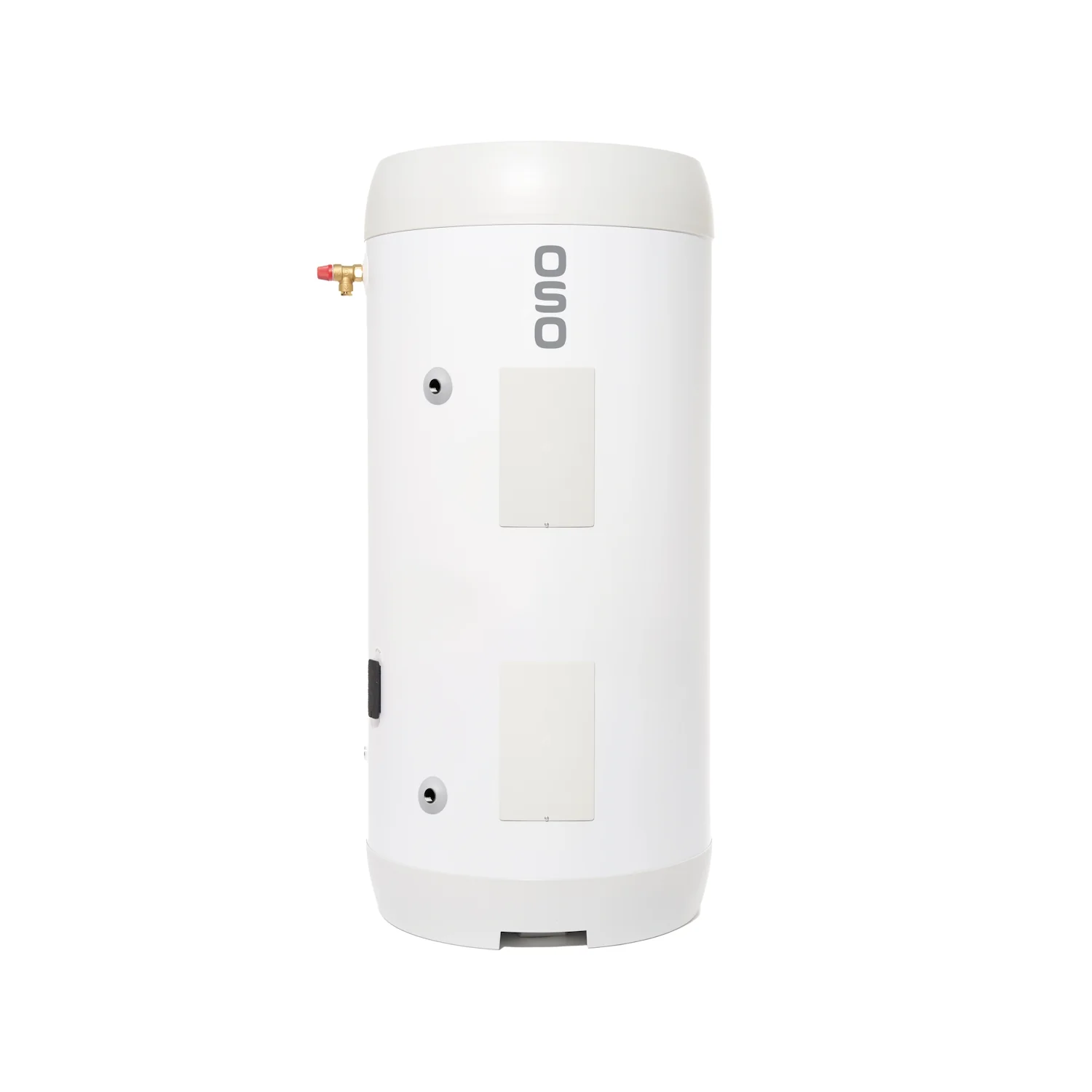

OSO Optima OGC300 Combined Heat Pump Cylinder & Buffer Tank | 225L DHW + 65L Buffer
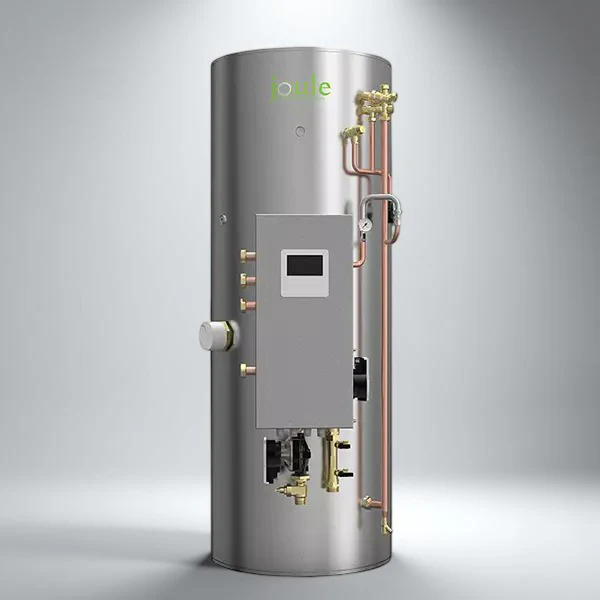
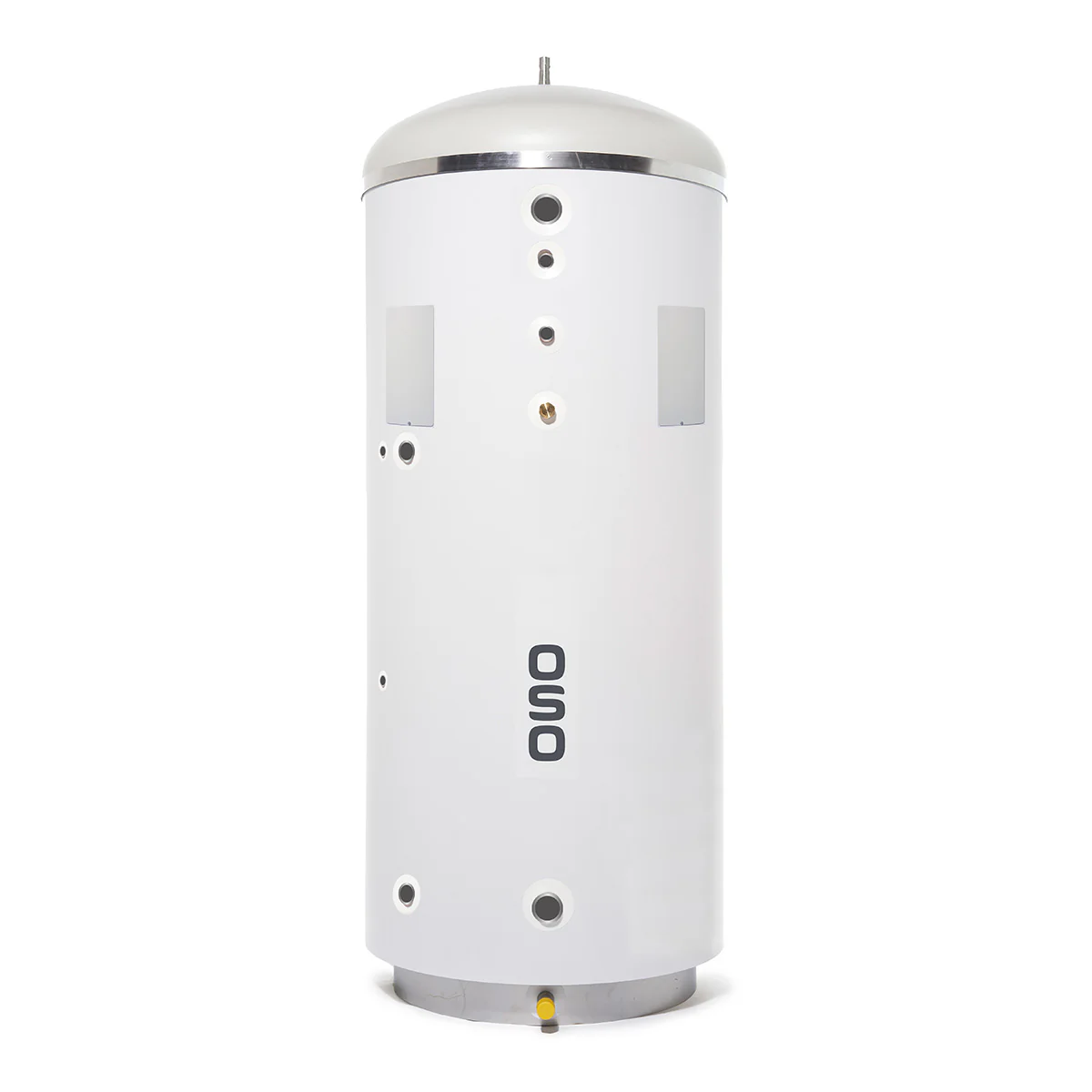
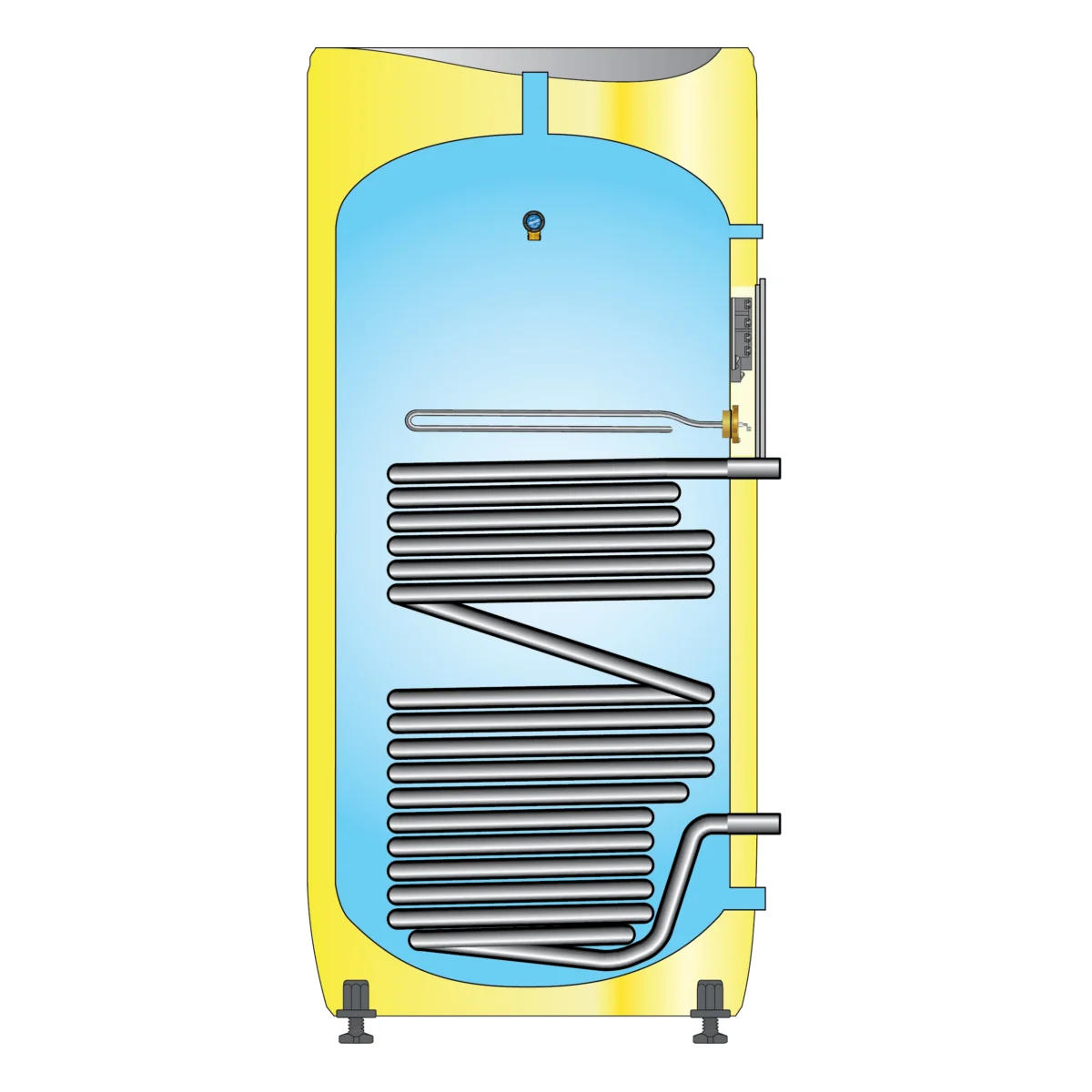
The OSO Optima OGC300 is a unique combined domestic hot water cylinder and buffer/volumiser tank in a single footprint, purpose-built for air source and ground source heat pump installations. Rather than requiring a separate cylinder and buffer tank with linking pipework between them, the OGC300 integrates a 225-litre DHW cylinder (upper section) and a 65-litre buffer/volumiser vessel (lower section) within a single insulated stainless steel casing, 595mm in diameter and 1,776mm tall. This dramatically reduces the space, pipework, and labour required compared to a conventional two-tank heat pump system. The buffer pre-heats the DHW cylinder continuously, which keeps the heat pump's Coefficient of Performance (COP) high by maintaining a steady load. When domestic hot water is called for, the heat pump reaches the required temperature faster because the cylinder is never fully cold — reducing the time the property is deprived of space heating during DHW mode. The OGC300 can serve heat pumps up to 15 kW output, supports a 36.5 kW rated coil, and is backed by a 10-year cylinder warranty. A 2.8 kW INCOTEC backup immersion heater — connectable to solar PV — provides supplementary DHW heating when required.
- Single-footprint, two-tank design — 225L DHW cylinder and 65L buffer/volumiser in one 595mm diameter unit, eliminating a separate buffer tank and all the pipework between them
- Pre-heating keeps COP high — the buffer continuously pre-warms the DHW cylinder, maintaining a steady heat pump load, avoiding cold-start efficiency losses and preserving the optimal Coefficient of Performance
- Shorter DHW-mode cycles — because the cylinder is never fully cold, the heat pump reaches the required DHW temperature faster, reducing the time the property goes without space heating
- Compatible with heat pumps up to 15 kW — suitable for the majority of domestic ASHP and GSHP systems currently installed in the UK
- 36.5 kW rated heating coil — high-capacity primary coil for fast heat-up and recovery (19-minute heat-up from 10°C; 13-minute 70% recovery time)
- 355-litre effective hot water capacity at 40°C — significantly more usable hot water than the nominal 225L cylinder volume, thanks to OSO's high-temperature stratification
- Dual A energy ratings — both DHW cylinder (upper) and buffer (lower) achieve ErP A class, supporting Building Regulations compliance and SAP calculations
- 2.8 kW INCOTEC backup immersion heater — provides DHW boost or backup when the heat pump is in maintenance, service, or defrost mode; connectable to solar PV for maximum self-consumption
- Solar PV ready — immersion heater position allows 100% of the DHW cylinder to be heated from solar PV or mains, maximising renewable self-consumption
- NANOPUR + VIP insulation — combination of PUR foam and Vacuum Insulation Panels (VIP) for exceptional standby heat retention, achieving just 45W / 1.08 kWh per day (DHW) and 20W / 0.74 kWh per day (buffer)
- ULTRAWELD stainless steel construction — laser-welded Duplex stainless steel cylinder resists corrosion in all water conditions; 10-year cylinder warranty
- S-DESIGN hidden connections — all pipework connections are concealed, keeping the plant room installation clean and professional
- Integrated G3 Building Regulations kit — 18L expansion vessel, inlet control valve (strainer, PRV, expansion relief), and tundish all factory-fitted, simplifying compliance
- Separate pressure circuits — upper DHW cylinder rated to 10 bar; lower buffer circuit rated to 2.5 bar (0.20 MPa), correctly matched to heat pump system pressures
- Temperature sensor slots — two sensor pockets (6mm and 8mm) pre-fitted for heat pump controller compatibility, supporting most ASHP and GSHP control systems
- TARIFF-READY immersion — backup immersion heater can be connected to off-peak electricity tariffs for cost-effective DHW top-up
- Heat pump runs in space heating mode: Heat is circulated through the lower buffer vessel, maintaining it at heat pump flow temperature. The buffer is slowly pre-heating the DHW cylinder via the internal coil.
- DHW demand is triggered (by timer or temperature drop): The heat pump's three-way valve diverts flow into dedicated DHW mode, now heating the pre-warmed DHW cylinder via the primary coil. Because the cylinder is already partially warm, this cycle is significantly shorter than with a cold cylinder.
- DHW cylinder reaches setpoint: The heat pump returns to space heating mode. The shorter DHW cycle means less time the property goes without space heating — improving comfort, particularly in colder weather.
- Backup immersion provides top-up or boost: If the heat pump cannot meet DHW demand (e.g. during defrost, maintenance, or extreme cold), the 2.8 kW INCOTEC immersion heater activates to maintain DHW temperature. This can also be triggered by solar PV export for maximum self-consumption.
- COP remains high throughout: Because the buffer always provides a heat pump load, the heat pump avoids short-cycling and operates at larger, more efficient run cycles — maintaining peak COP rather than degrading through frequent starts and stops.
| Specification | Unit | DHW Cylinder (Upper) | Buffer / Volumiser (Lower) |
|---|---|---|---|
| Product Number | OSO | 11003523 | |
| Product Name | OGC300 — Optima | ||
| Volume | L | 225 | 65 |
| Effective Capacity at 40°C | L | 355 (combined) | — |
| Outer Diameter | mm | 595 | |
| Overall Height | mm | 1,776 | |
| Weight (empty) | kg | 65 | |
| Weight (full / net) | kg | 355 | |
| Energy Rating (ErP) | A | A | |
| Standby Heat Loss | W | 45 | 20 |
| Standby Heat Loss / 24 hrs | kWh/day | 1.08 | 0.74 |
| Thermostat Setpoint (immersion) | °C | 40–70 (adjustable) | — |
| Safety Thermostat Cut-out | °C | 85 | — |
| Max Operating Temperature | °C | 70 | — |
| Max Design Pressure | bar | 10 | 2.5 |
| T&P Valve Rating | bar / °C | 7 / 90–95 | — |
| Primary Coil Power Output | kW | 36.5 | — |
| Primary Coil Surface Area | m² | 2.6 | — |
| Primary Flow Rate (design) | L/h | 900 | — |
| Heat-up Time from 10°C (coil) | min | 19 | — |
| Recovery Time to 70% (coil) | min | 13 | — |
| Backup Immersion Power | kW | 2.8 @ 230V / 3.0 @ 240V | — |
| Immersion Heater Material | Incoloy 825 (INCOTEC) | — | |
| Electrical Supply | V / Hz | 220–240 VAC / 50 Hz | — |
| IP Classification | IP21 | ||
| Insulation Material | PUR + Vacuum Insulation Panels (VIP) | ||
| Insulation Thickness (average) | mm | 50 | |
| Expansion Vessel (supplied) | L | 18 | — |
| Buffer Connections | inch BSP | — | G 1" female (upper & lower) |
| DHW Cold Water Inlet | inch BSP | G ¾" female | — |
| DHW Hot Water Outlet | inch BSP | G ¾" female | — |
| Coil Connections (upper & lower) | inch BSP | G ¾" female | — |
| Immersion Heater Connection | inch BSP | G 1¼" female | — |
| T&P Valve Connection | inch BSP | G ½" female (factory-fitted) | — |
| Temperature Sensor Pockets | 2 × (6mm and 8mm compatible) | ||
| Adjustable Feet Range | mm | 0–40 (factory-fitted) | |
| Min Servicing Clearance (front) | mm | 400 | |
| Min Servicing Clearance (above) | mm | 150 | |
| Certification | KIWA Watertec — Building & Water Regulations approved | ||
| UKCA Marking | Yes | ||
| Quality / Environmental | ISO 9001 / ISO 14001 / ISO 45001 | ||
| Cylinder Warranty | 10 years | ||
| Components Warranty | 2 years | ||
- Siting and floor preparation: Position the OGC300 on a solid, level floor capable of supporting 355 kg (full weight). Allow 400mm clearance in front of the junction box covers and 150mm above the top of the unit. Unscrew the adjustable feet a minimum of 15mm from the base before levelling.
- Fill the upper DHW cylinder first: Open the furthest hot water outlet and the mains cold supply stop cock. Allow water to flow until air is purged from the upper cylinder, then close taps and check all connections for leaks. The upper cylinder must be filled with water before the power is switched on.
- Connect the heat pump primary circuit: Connect the heat pump flow and return to the coil connections (E and F — G¾" female). Connect the buffer tank connections (C and D — G1" female) to the heat pump heating circuit as applicable. Fit a drain cock at the lowest point of the buffer circuit (not supplied). Fill and bleed the buffer/heating circuit in accordance with the heat pump manufacturer's instructions.
- Install temperature sensors: Fit 6mm or 8mm heat pump temperature sensors into the sensor pockets as required by your heat pump controller. Pull out the sensor bracket, insert the sensor, and refit ensuring full contact with the inner stainless steel wall surface.
- Connect DHW cold water inlet and hot water outlet: Connect mains cold water supply to connection H (G¾" female). Connect hot water outlet to connection K (G¾" female). A mixing valve (not supplied) is strongly recommended to prevent scalding at draw-off points — maximum stored temperature is 70°C.
- Connect T&P valve discharge and tundish: Connect the T&P valve discharge to a tundish and discharge pipe in accordance with Building Regulations Part G. Ensure a continuous fall to drain and a clear, visible discharge point. Discharge pipe must be metal rated to the relevant temperature.
- Electrical connections: Wire the 2.8 kW immersion heater to a dedicated 16A+ supply with a 20A double-pole isolation switch (3mm separation). Mains cable must withstand 90°C. Fit strain relievers (supplied) to both junction box cable entries. Do not switch on power until both vessels are filled with water.
- Commission and test: Verify all pipe connections for tightness and leaks. Test T&P valve by turning the knob counter-clockwise and confirming free flow to drain. Adjust immersion thermostat (40–70°C, minimum 60°C for Legionella prevention). Complete the G3 commissioning logbook (supplied) and hand all documentation to the customer.
Original: $2,768.17
-65%$2,768.17
$968.86More Images


OSO Optima OGC300 Combined Heat Pump Cylinder & Buffer Tank | 225L DHW + 65L Buffer
The OSO Optima OGC300 is a unique combined domestic hot water cylinder and buffer/volumiser tank in a single footprint, purpose-built for air source and ground source heat pump installations. Rather than requiring a separate cylinder and buffer tank with linking pipework between them, the OGC300 integrates a 225-litre DHW cylinder (upper section) and a 65-litre buffer/volumiser vessel (lower section) within a single insulated stainless steel casing, 595mm in diameter and 1,776mm tall. This dramatically reduces the space, pipework, and labour required compared to a conventional two-tank heat pump system. The buffer pre-heats the DHW cylinder continuously, which keeps the heat pump's Coefficient of Performance (COP) high by maintaining a steady load. When domestic hot water is called for, the heat pump reaches the required temperature faster because the cylinder is never fully cold — reducing the time the property is deprived of space heating during DHW mode. The OGC300 can serve heat pumps up to 15 kW output, supports a 36.5 kW rated coil, and is backed by a 10-year cylinder warranty. A 2.8 kW INCOTEC backup immersion heater — connectable to solar PV — provides supplementary DHW heating when required.
- Single-footprint, two-tank design — 225L DHW cylinder and 65L buffer/volumiser in one 595mm diameter unit, eliminating a separate buffer tank and all the pipework between them
- Pre-heating keeps COP high — the buffer continuously pre-warms the DHW cylinder, maintaining a steady heat pump load, avoiding cold-start efficiency losses and preserving the optimal Coefficient of Performance
- Shorter DHW-mode cycles — because the cylinder is never fully cold, the heat pump reaches the required DHW temperature faster, reducing the time the property goes without space heating
- Compatible with heat pumps up to 15 kW — suitable for the majority of domestic ASHP and GSHP systems currently installed in the UK
- 36.5 kW rated heating coil — high-capacity primary coil for fast heat-up and recovery (19-minute heat-up from 10°C; 13-minute 70% recovery time)
- 355-litre effective hot water capacity at 40°C — significantly more usable hot water than the nominal 225L cylinder volume, thanks to OSO's high-temperature stratification
- Dual A energy ratings — both DHW cylinder (upper) and buffer (lower) achieve ErP A class, supporting Building Regulations compliance and SAP calculations
- 2.8 kW INCOTEC backup immersion heater — provides DHW boost or backup when the heat pump is in maintenance, service, or defrost mode; connectable to solar PV for maximum self-consumption
- Solar PV ready — immersion heater position allows 100% of the DHW cylinder to be heated from solar PV or mains, maximising renewable self-consumption
- NANOPUR + VIP insulation — combination of PUR foam and Vacuum Insulation Panels (VIP) for exceptional standby heat retention, achieving just 45W / 1.08 kWh per day (DHW) and 20W / 0.74 kWh per day (buffer)
- ULTRAWELD stainless steel construction — laser-welded Duplex stainless steel cylinder resists corrosion in all water conditions; 10-year cylinder warranty
- S-DESIGN hidden connections — all pipework connections are concealed, keeping the plant room installation clean and professional
- Integrated G3 Building Regulations kit — 18L expansion vessel, inlet control valve (strainer, PRV, expansion relief), and tundish all factory-fitted, simplifying compliance
- Separate pressure circuits — upper DHW cylinder rated to 10 bar; lower buffer circuit rated to 2.5 bar (0.20 MPa), correctly matched to heat pump system pressures
- Temperature sensor slots — two sensor pockets (6mm and 8mm) pre-fitted for heat pump controller compatibility, supporting most ASHP and GSHP control systems
- TARIFF-READY immersion — backup immersion heater can be connected to off-peak electricity tariffs for cost-effective DHW top-up
- Heat pump runs in space heating mode: Heat is circulated through the lower buffer vessel, maintaining it at heat pump flow temperature. The buffer is slowly pre-heating the DHW cylinder via the internal coil.
- DHW demand is triggered (by timer or temperature drop): The heat pump's three-way valve diverts flow into dedicated DHW mode, now heating the pre-warmed DHW cylinder via the primary coil. Because the cylinder is already partially warm, this cycle is significantly shorter than with a cold cylinder.
- DHW cylinder reaches setpoint: The heat pump returns to space heating mode. The shorter DHW cycle means less time the property goes without space heating — improving comfort, particularly in colder weather.
- Backup immersion provides top-up or boost: If the heat pump cannot meet DHW demand (e.g. during defrost, maintenance, or extreme cold), the 2.8 kW INCOTEC immersion heater activates to maintain DHW temperature. This can also be triggered by solar PV export for maximum self-consumption.
- COP remains high throughout: Because the buffer always provides a heat pump load, the heat pump avoids short-cycling and operates at larger, more efficient run cycles — maintaining peak COP rather than degrading through frequent starts and stops.
| Specification | Unit | DHW Cylinder (Upper) | Buffer / Volumiser (Lower) |
|---|---|---|---|
| Product Number | OSO | 11003523 | |
| Product Name | OGC300 — Optima | ||
| Volume | L | 225 | 65 |
| Effective Capacity at 40°C | L | 355 (combined) | — |
| Outer Diameter | mm | 595 | |
| Overall Height | mm | 1,776 | |
| Weight (empty) | kg | 65 | |
| Weight (full / net) | kg | 355 | |
| Energy Rating (ErP) | A | A | |
| Standby Heat Loss | W | 45 | 20 |
| Standby Heat Loss / 24 hrs | kWh/day | 1.08 | 0.74 |
| Thermostat Setpoint (immersion) | °C | 40–70 (adjustable) | — |
| Safety Thermostat Cut-out | °C | 85 | — |
| Max Operating Temperature | °C | 70 | — |
| Max Design Pressure | bar | 10 | 2.5 |
| T&P Valve Rating | bar / °C | 7 / 90–95 | — |
| Primary Coil Power Output | kW | 36.5 | — |
| Primary Coil Surface Area | m² | 2.6 | — |
| Primary Flow Rate (design) | L/h | 900 | — |
| Heat-up Time from 10°C (coil) | min | 19 | — |
| Recovery Time to 70% (coil) | min | 13 | — |
| Backup Immersion Power | kW | 2.8 @ 230V / 3.0 @ 240V | — |
| Immersion Heater Material | Incoloy 825 (INCOTEC) | — | |
| Electrical Supply | V / Hz | 220–240 VAC / 50 Hz | — |
| IP Classification | IP21 | ||
| Insulation Material | PUR + Vacuum Insulation Panels (VIP) | ||
| Insulation Thickness (average) | mm | 50 | |
| Expansion Vessel (supplied) | L | 18 | — |
| Buffer Connections | inch BSP | — | G 1" female (upper & lower) |
| DHW Cold Water Inlet | inch BSP | G ¾" female | — |
| DHW Hot Water Outlet | inch BSP | G ¾" female | — |
| Coil Connections (upper & lower) | inch BSP | G ¾" female | — |
| Immersion Heater Connection | inch BSP | G 1¼" female | — |
| T&P Valve Connection | inch BSP | G ½" female (factory-fitted) | — |
| Temperature Sensor Pockets | 2 × (6mm and 8mm compatible) | ||
| Adjustable Feet Range | mm | 0–40 (factory-fitted) | |
| Min Servicing Clearance (front) | mm | 400 | |
| Min Servicing Clearance (above) | mm | 150 | |
| Certification | KIWA Watertec — Building & Water Regulations approved | ||
| UKCA Marking | Yes | ||
| Quality / Environmental | ISO 9001 / ISO 14001 / ISO 45001 | ||
| Cylinder Warranty | 10 years | ||
| Components Warranty | 2 years | ||
- Siting and floor preparation: Position the OGC300 on a solid, level floor capable of supporting 355 kg (full weight). Allow 400mm clearance in front of the junction box covers and 150mm above the top of the unit. Unscrew the adjustable feet a minimum of 15mm from the base before levelling.
- Fill the upper DHW cylinder first: Open the furthest hot water outlet and the mains cold supply stop cock. Allow water to flow until air is purged from the upper cylinder, then close taps and check all connections for leaks. The upper cylinder must be filled with water before the power is switched on.
- Connect the heat pump primary circuit: Connect the heat pump flow and return to the coil connections (E and F — G¾" female). Connect the buffer tank connections (C and D — G1" female) to the heat pump heating circuit as applicable. Fit a drain cock at the lowest point of the buffer circuit (not supplied). Fill and bleed the buffer/heating circuit in accordance with the heat pump manufacturer's instructions.
- Install temperature sensors: Fit 6mm or 8mm heat pump temperature sensors into the sensor pockets as required by your heat pump controller. Pull out the sensor bracket, insert the sensor, and refit ensuring full contact with the inner stainless steel wall surface.
- Connect DHW cold water inlet and hot water outlet: Connect mains cold water supply to connection H (G¾" female). Connect hot water outlet to connection K (G¾" female). A mixing valve (not supplied) is strongly recommended to prevent scalding at draw-off points — maximum stored temperature is 70°C.
- Connect T&P valve discharge and tundish: Connect the T&P valve discharge to a tundish and discharge pipe in accordance with Building Regulations Part G. Ensure a continuous fall to drain and a clear, visible discharge point. Discharge pipe must be metal rated to the relevant temperature.
- Electrical connections: Wire the 2.8 kW immersion heater to a dedicated 16A+ supply with a 20A double-pole isolation switch (3mm separation). Mains cable must withstand 90°C. Fit strain relievers (supplied) to both junction box cable entries. Do not switch on power until both vessels are filled with water.
- Commission and test: Verify all pipe connections for tightness and leaks. Test T&P valve by turning the knob counter-clockwise and confirming free flow to drain. Adjust immersion thermostat (40–70°C, minimum 60°C for Legionella prevention). Complete the G3 commissioning logbook (supplied) and hand all documentation to the customer.
Product Information
Product Information
Shipping & Returns
Shipping & Returns
Description
The OSO Optima OGC300 is a unique combined domestic hot water cylinder and buffer/volumiser tank in a single footprint, purpose-built for air source and ground source heat pump installations. Rather than requiring a separate cylinder and buffer tank with linking pipework between them, the OGC300 integrates a 225-litre DHW cylinder (upper section) and a 65-litre buffer/volumiser vessel (lower section) within a single insulated stainless steel casing, 595mm in diameter and 1,776mm tall. This dramatically reduces the space, pipework, and labour required compared to a conventional two-tank heat pump system. The buffer pre-heats the DHW cylinder continuously, which keeps the heat pump's Coefficient of Performance (COP) high by maintaining a steady load. When domestic hot water is called for, the heat pump reaches the required temperature faster because the cylinder is never fully cold — reducing the time the property is deprived of space heating during DHW mode. The OGC300 can serve heat pumps up to 15 kW output, supports a 36.5 kW rated coil, and is backed by a 10-year cylinder warranty. A 2.8 kW INCOTEC backup immersion heater — connectable to solar PV — provides supplementary DHW heating when required.
- Single-footprint, two-tank design — 225L DHW cylinder and 65L buffer/volumiser in one 595mm diameter unit, eliminating a separate buffer tank and all the pipework between them
- Pre-heating keeps COP high — the buffer continuously pre-warms the DHW cylinder, maintaining a steady heat pump load, avoiding cold-start efficiency losses and preserving the optimal Coefficient of Performance
- Shorter DHW-mode cycles — because the cylinder is never fully cold, the heat pump reaches the required DHW temperature faster, reducing the time the property goes without space heating
- Compatible with heat pumps up to 15 kW — suitable for the majority of domestic ASHP and GSHP systems currently installed in the UK
- 36.5 kW rated heating coil — high-capacity primary coil for fast heat-up and recovery (19-minute heat-up from 10°C; 13-minute 70% recovery time)
- 355-litre effective hot water capacity at 40°C — significantly more usable hot water than the nominal 225L cylinder volume, thanks to OSO's high-temperature stratification
- Dual A energy ratings — both DHW cylinder (upper) and buffer (lower) achieve ErP A class, supporting Building Regulations compliance and SAP calculations
- 2.8 kW INCOTEC backup immersion heater — provides DHW boost or backup when the heat pump is in maintenance, service, or defrost mode; connectable to solar PV for maximum self-consumption
- Solar PV ready — immersion heater position allows 100% of the DHW cylinder to be heated from solar PV or mains, maximising renewable self-consumption
- NANOPUR + VIP insulation — combination of PUR foam and Vacuum Insulation Panels (VIP) for exceptional standby heat retention, achieving just 45W / 1.08 kWh per day (DHW) and 20W / 0.74 kWh per day (buffer)
- ULTRAWELD stainless steel construction — laser-welded Duplex stainless steel cylinder resists corrosion in all water conditions; 10-year cylinder warranty
- S-DESIGN hidden connections — all pipework connections are concealed, keeping the plant room installation clean and professional
- Integrated G3 Building Regulations kit — 18L expansion vessel, inlet control valve (strainer, PRV, expansion relief), and tundish all factory-fitted, simplifying compliance
- Separate pressure circuits — upper DHW cylinder rated to 10 bar; lower buffer circuit rated to 2.5 bar (0.20 MPa), correctly matched to heat pump system pressures
- Temperature sensor slots — two sensor pockets (6mm and 8mm) pre-fitted for heat pump controller compatibility, supporting most ASHP and GSHP control systems
- TARIFF-READY immersion — backup immersion heater can be connected to off-peak electricity tariffs for cost-effective DHW top-up
- Heat pump runs in space heating mode: Heat is circulated through the lower buffer vessel, maintaining it at heat pump flow temperature. The buffer is slowly pre-heating the DHW cylinder via the internal coil.
- DHW demand is triggered (by timer or temperature drop): The heat pump's three-way valve diverts flow into dedicated DHW mode, now heating the pre-warmed DHW cylinder via the primary coil. Because the cylinder is already partially warm, this cycle is significantly shorter than with a cold cylinder.
- DHW cylinder reaches setpoint: The heat pump returns to space heating mode. The shorter DHW cycle means less time the property goes without space heating — improving comfort, particularly in colder weather.
- Backup immersion provides top-up or boost: If the heat pump cannot meet DHW demand (e.g. during defrost, maintenance, or extreme cold), the 2.8 kW INCOTEC immersion heater activates to maintain DHW temperature. This can also be triggered by solar PV export for maximum self-consumption.
- COP remains high throughout: Because the buffer always provides a heat pump load, the heat pump avoids short-cycling and operates at larger, more efficient run cycles — maintaining peak COP rather than degrading through frequent starts and stops.
| Specification | Unit | DHW Cylinder (Upper) | Buffer / Volumiser (Lower) |
|---|---|---|---|
| Product Number | OSO | 11003523 | |
| Product Name | OGC300 — Optima | ||
| Volume | L | 225 | 65 |
| Effective Capacity at 40°C | L | 355 (combined) | — |
| Outer Diameter | mm | 595 | |
| Overall Height | mm | 1,776 | |
| Weight (empty) | kg | 65 | |
| Weight (full / net) | kg | 355 | |
| Energy Rating (ErP) | A | A | |
| Standby Heat Loss | W | 45 | 20 |
| Standby Heat Loss / 24 hrs | kWh/day | 1.08 | 0.74 |
| Thermostat Setpoint (immersion) | °C | 40–70 (adjustable) | — |
| Safety Thermostat Cut-out | °C | 85 | — |
| Max Operating Temperature | °C | 70 | — |
| Max Design Pressure | bar | 10 | 2.5 |
| T&P Valve Rating | bar / °C | 7 / 90–95 | — |
| Primary Coil Power Output | kW | 36.5 | — |
| Primary Coil Surface Area | m² | 2.6 | — |
| Primary Flow Rate (design) | L/h | 900 | — |
| Heat-up Time from 10°C (coil) | min | 19 | — |
| Recovery Time to 70% (coil) | min | 13 | — |
| Backup Immersion Power | kW | 2.8 @ 230V / 3.0 @ 240V | — |
| Immersion Heater Material | Incoloy 825 (INCOTEC) | — | |
| Electrical Supply | V / Hz | 220–240 VAC / 50 Hz | — |
| IP Classification | IP21 | ||
| Insulation Material | PUR + Vacuum Insulation Panels (VIP) | ||
| Insulation Thickness (average) | mm | 50 | |
| Expansion Vessel (supplied) | L | 18 | — |
| Buffer Connections | inch BSP | — | G 1" female (upper & lower) |
| DHW Cold Water Inlet | inch BSP | G ¾" female | — |
| DHW Hot Water Outlet | inch BSP | G ¾" female | — |
| Coil Connections (upper & lower) | inch BSP | G ¾" female | — |
| Immersion Heater Connection | inch BSP | G 1¼" female | — |
| T&P Valve Connection | inch BSP | G ½" female (factory-fitted) | — |
| Temperature Sensor Pockets | 2 × (6mm and 8mm compatible) | ||
| Adjustable Feet Range | mm | 0–40 (factory-fitted) | |
| Min Servicing Clearance (front) | mm | 400 | |
| Min Servicing Clearance (above) | mm | 150 | |
| Certification | KIWA Watertec — Building & Water Regulations approved | ||
| UKCA Marking | Yes | ||
| Quality / Environmental | ISO 9001 / ISO 14001 / ISO 45001 | ||
| Cylinder Warranty | 10 years | ||
| Components Warranty | 2 years | ||
- Siting and floor preparation: Position the OGC300 on a solid, level floor capable of supporting 355 kg (full weight). Allow 400mm clearance in front of the junction box covers and 150mm above the top of the unit. Unscrew the adjustable feet a minimum of 15mm from the base before levelling.
- Fill the upper DHW cylinder first: Open the furthest hot water outlet and the mains cold supply stop cock. Allow water to flow until air is purged from the upper cylinder, then close taps and check all connections for leaks. The upper cylinder must be filled with water before the power is switched on.
- Connect the heat pump primary circuit: Connect the heat pump flow and return to the coil connections (E and F — G¾" female). Connect the buffer tank connections (C and D — G1" female) to the heat pump heating circuit as applicable. Fit a drain cock at the lowest point of the buffer circuit (not supplied). Fill and bleed the buffer/heating circuit in accordance with the heat pump manufacturer's instructions.
- Install temperature sensors: Fit 6mm or 8mm heat pump temperature sensors into the sensor pockets as required by your heat pump controller. Pull out the sensor bracket, insert the sensor, and refit ensuring full contact with the inner stainless steel wall surface.
- Connect DHW cold water inlet and hot water outlet: Connect mains cold water supply to connection H (G¾" female). Connect hot water outlet to connection K (G¾" female). A mixing valve (not supplied) is strongly recommended to prevent scalding at draw-off points — maximum stored temperature is 70°C.
- Connect T&P valve discharge and tundish: Connect the T&P valve discharge to a tundish and discharge pipe in accordance with Building Regulations Part G. Ensure a continuous fall to drain and a clear, visible discharge point. Discharge pipe must be metal rated to the relevant temperature.
- Electrical connections: Wire the 2.8 kW immersion heater to a dedicated 16A+ supply with a 20A double-pole isolation switch (3mm separation). Mains cable must withstand 90°C. Fit strain relievers (supplied) to both junction box cable entries. Do not switch on power until both vessels are filled with water.
- Commission and test: Verify all pipe connections for tightness and leaks. Test T&P valve by turning the knob counter-clockwise and confirming free flow to drain. Adjust immersion thermostat (40–70°C, minimum 60°C for Legionella prevention). Complete the G3 commissioning logbook (supplied) and hand all documentation to the customer.